Our Rating: 8.5/10
There are countless films about Frida Kahlo. Few allow her to speak for herself.
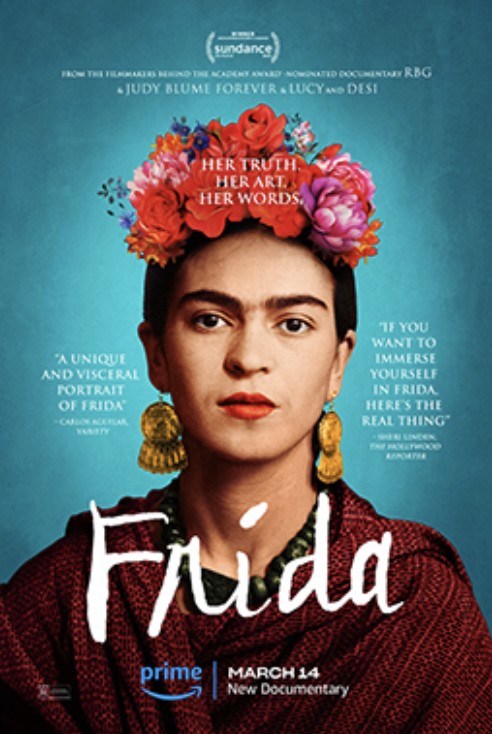
Directed by Carla Gutiérrez in her feature debut, Frida premiered at the 2024 Sundance Film Festival, where it won the Jonathan Oppenheim Editing Award, before being released globally on Amazon Prime Video on March 14, 2024. From the outset, it positions itself differently from traditional artist biopics. This is not a glossy retrospective. It is an interior portrait.
The premise is deceptively simple. The film constructs Frida Kahlo’s life through her own diaries, letters and interviews. Her words guide the narrative. Animation is layered over archival footage and photography, bringing her paintings into motion without turning them into spectacle. The result is immersive rather than performative. You are not being told who she was. You are hearing how she understood herself.
What emerges is a woman of sharp intellect and relentless self awareness. Her physical suffering following the catastrophic bus accident is not romanticised. It is contextualised. Her marriage to Diego Rivera is neither flattened into tragedy nor mythologised into passion. It is shown as complicated, creative and often painful. She is not framed as a muse orbiting a male genius. She is the genius.
The documentary leans unapologetically into the political dimension of her life. Her communist beliefs, her rejection of imposed femininity, her bisexuality and her refusal to conform are woven into the storytelling without sensationalism. The feminist current is undeniable. Frida’s body was scrutinised. Her pain was public. Her defiance was deliberate. The film makes clear that her art was not decorative self expression. It was reclamation.
Visually, the blend of animation and archive could have felt indulgent. Instead, it feels necessary. The animation does not overpower the material. It deepens it. It creates space for emotion without distorting fact. The pacing is measured, occasionally reflective to the point of stillness, but that stillness suits the subject. Frida was not a rushed life. She was a layered one.
What the film ultimately achieves is intimacy. It strips away the commercial iconography that has turned her face into merchandise and returns to the woman who wrote, painted and bled behind it.
This is not a museum piece. It is a reclamation.
A vivid, thoughtful documentary that restores complexity and agency to one of the most misappropriated figures in modern art history.

 The Industry Review
Leave a comment