
A new UK Music report titled “Black Music Means Business” quantifies what has long been understood but rarely measured: Black music is not a category within the UK industry; it is the foundation of it. The data now makes that impossible to ignore. This report proves that Black music isn’t just a category—it accounts for 80% of the market. So why is the industry still failing its creators?
By Linda Coogan Byrne
For years, people working in Black music in the UK have been told some version of the same thing. That the culture is valued, the impact is recognised, and the usual line that “things are improving.” This report does not deal in sentiment. It deals in measurement and data. And once you measure it properly, the imbalance becomes very hard to ignore.
Let’s start with what the report actually proves
Black music accounts for £24.5 billion of the UK’s £30 billion recorded music market over the past 30 years. That is more than 80%. That figure alone reframes the entire industry.
What sits inside that number
The report is very clear about what is being counted. It is not just artists in obvious categories like grime or hip-hop. It includes music rooted in Black cultural traditions across genres, including what the industry routinely labels as pop and rock. So the obvious question is: how is that being measured?
What they actually measured
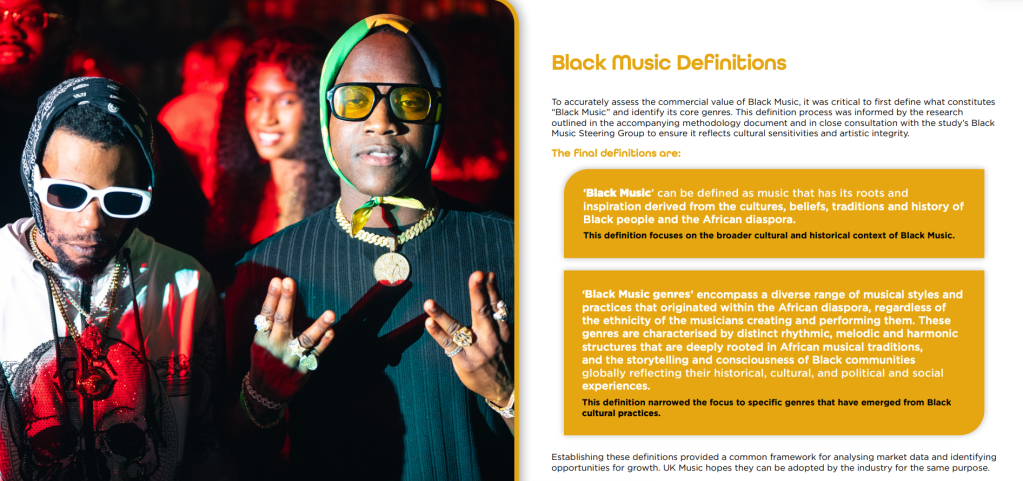
This is where the report shifts the ground. They did not measure artists by identity; they measured music by origin. Black music is defined as music rooted in the cultures, traditions and history of the African diaspora.
The report uses a “genealogical” approach—if the core DNA of a track (its rhythm, structure, or vocal style) is rooted in the African diaspora, it is counted. It acknowledges that influence isn’t a vague feeling; it’s a measurable architectural component of a song. So the question is not whether an artist is Black. The question is whether the sound, structure and genre come from Black musical traditions. That changes the frame completely.
The structure behind the numbers
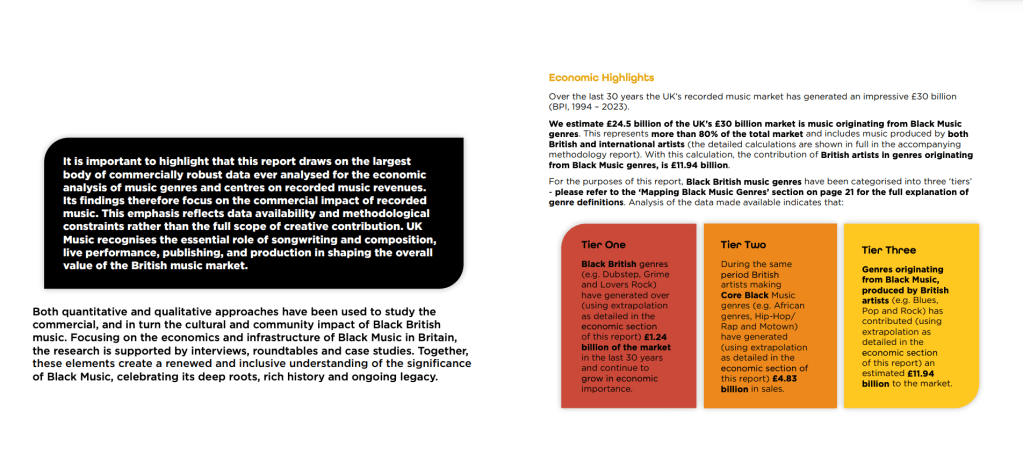
To avoid flattening everything into one category, the report builds a three-tier system:
- Tier 1: Black British genres such as Dubstep, Grime and Lovers Rock.
- Tier 2: Core Black genres such as Hip-hop, Rap, and Motown.
- Tier 3: Genres derived from Black music, including large parts of mainstream pop, rock, and blues music.
That third tier carries the most weight. It covers 72 genres. A significant portion of what is marketed as “mainstream” sits here because those genres are historically built from Black musical forms—blues, jazz, soul, gospel. The lineage is clear, and the report follows it.
This is based on real consumption

The report is not built on opinion. It analyses 10,000 top-selling singles and 15,000 top-selling albums over a 30-year period using Album Equivalent Sales (combining streaming, downloads and physical sales).
Across the three tiers, the breakdown is staggering:
- Black British genres → £1.24 billion
- Core Black genres → £4.83 billion
- Genres derived from Black music → £11.94 billion (British artists alone)
When international artists working within those same genres are included, the total reaches £24.5 billion. At that point, this is not “influence”. This is the core of the market.
The Financial Reality Behind the Percentages
The report puts a precise price tag on the systemic barriers within this multi-billion pound sector. Data from Black Lives in Music reveals a stark 21% pay gap for creators: the average Black musician earns just £1,155 a month, compared to £1,454 for non-Black musicians.
The disparity follows professionals into the boardroom. Black music executives take home an average of £1,964 a month, while their non-Black counterparts earn £2,459—a 20% gap. In an industry that prides itself on being “progressive”, the pay gap for Black creators is more than double the UK’s national average. The culture is being exported, but the creators are being underpaid.
A Nationwide Ecosystem Under Pressure
This is not just a London story. The report maps a nationwide ecosystem sustaining this output, highlighting the DIY ethos driving scenes from Bristol’s Bass culture to Glasgow’s Afro-Celt fusions. Much of this developed without institutional backing.
However, representation and output are not aligned. While Black music drives consumption, Black British artists accounted for only 11% of the top 100 artists in 2023. Furthermore, interviews with 76 Black creators detailed a persistent “Glass Cliff” phenomenon—where Black executives are placed in challenging roles without adequate support—and a widespread reliance on precarious self-employment simply to survive a system built for others.

The Proof of Concept: Success Against the Odds
The artists who break through are not just participating in the market; they are redefining it across every conceivable genre and era. These are not “niche” success stories; they are the benchmarks of the modern global industry.
The Heritage of Excellence
- Sade: A global icon with over 75 million units sold worldwide, her legacy spans four decades, multiple Grammys, and a 2024 nomination for the Rock and Roll Hall of Fame.
- Soul II Soul: Born from the South London pirate radio movement, the collective defined the sound of the late 80s, winning two Grammys and proving that grassroots UK Black culture had global commercial legs.
- Professor Shirley J Thompson OBE: Breaking barriers in the classical world, she became the first woman in Europe to compose and conduct a symphony in 40 years, proving the “Black Music Ecosystem” spans from the streets to the most prestigious concert halls.
The Modern Titans
- Stormzy & Dave: Stormzy’s historic 2019 Glastonbury headline set cemented Grime as a global phenomenon. Alongside him, Dave has redefined the commercial ceiling for UK rap, becoming the first artist in the genre to debut three consecutive albums at number one.
- Raye: After years of systemic industry friction, her 2024 sweep of six BRIT Awards in a single night as an independent artist set a 48-year record—a living testament to the power of creative autonomy.
The New Global Vanguard
- Little Simz & Ezra Collective: With consecutive Mercury Prize wins in 2022 and 2023, these artists proved that independent, genre-blurring music—from conscious rap to jazz—is the UK’s most critically acclaimed export.
- Olivia Dean & PinkPantheress: Moving from viral digital beginnings to dominating the 2025 and 2026 award cycles, these artists represent a new era of global pop dominance, with Dean securing Grammy wins and PinkPantheress being named 2026 Producer of the Year.
- Myles Smith & Michael Kiwanuka: From Smith’s multi-platinum breakout hits in 2024 to Kiwanuka’s Mercury-winning soul, these artists illustrate the sheer breadth of the diaspora’s influence on the “mainstream” sound.
These stories aren’t just feel-good anecdotes. They are the proof of what happens when the “Black Music Ecosystem” is allowed to lead. They represent the massive, untapped potential of the 89% of Black British artists who are still waiting for a seat at a table they helped build.
The Blueprint for Change
The report does not leave the industry with just a diagnosis; it hands over an eight-point prescription. If the UK music market wants to maintain its global edge, it has to rebuild its foundation. The recommendations include:
- Co-Design and Institutional Funding: Establish dedicated government funding for performance spaces, studios, and archives, co-designed by Black music leaders.
- Music Education Review: Revise the national curriculum so that Black music genres are taught as a core part of British music history.
- Targeted Growth Investment: Dedicate a specific proportion of the government’s £30 million Music Growth Package directly to Black-led organisations.
- Equitable Partnerships: Mandate that established Black music specialists serve as the first point of contact for developing Tier 1 and Tier 2 genres.
Final word
This report does not introduce a new argument. It documents an existing one properly. It shows where the money comes from, how genres are built, how value moves through the system, and exactly where that value stops.
Once those facts are laid side by side, the conversation changes. The question is no longer whether Black music matters to the UK industry. The data answers that. The question now is whether the industry is finally ready to put its money where its market is.
Congrats to UK Music and all who were involved in putting this report together. Data changes everything. It cannot be hailed as opinion; it is historic value and proof of what we all knew but can now finally prove.
Be sure to take time to read the whole report here.

 The Industry Review
Leave a comment