Book Review
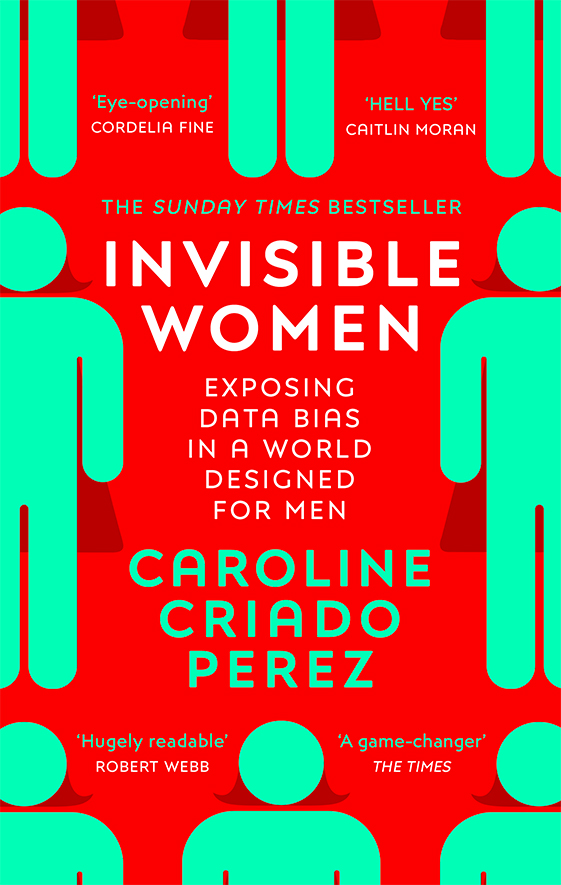
Invisible Women is the kind of book that shifts your perspective in small, permanent ways. After reading it, everyday systems start to look slightly different. You begin to notice assumptions that once felt neutral.
Caroline Criado Perez builds her argument around a deceptively simple premise. Much of the modern world has been designed around male bodies and male life patterns. When women are excluded from data collection, research samples or policy modelling, that exclusion shapes outcomes. The absence does not announce itself. It simply embeds itself in decisions.
The examples are drawn from ordinary parts of life. Medical research that historically relied on male test subjects, with results later generalised to everyone. Urban transport systems planned around linear commuting patterns, despite many women navigating more complex daily journeys shaped by caregiving and part-time work. Car safety testing based on crash dummies modelled on male physiques, leaving women statistically more vulnerable in collisions.
None of this is presented as deliberate malice. That is precisely what makes it unsettling. The issue is not overt discrimination. It is structural oversight that has hardened into normal practice.
Perez writes with clarity and control. She does not rely on rhetorical flourish. Instead, she assembles evidence patiently. Study follows study. Sector after sector. The cumulative effect is difficult to ignore. Healthcare, infrastructure, technology and workplace design all reveal variations of the same assumption: male experience stands in for human experience.
At times the density of research can feel heavy, but that weight strengthens the argument. The book reads less like polemic and more like a sustained investigation. It invites scrutiny rather than avoiding it.
For readers involved in governance, media or cultural industries, the implications extend beyond the specific examples. It prompts reflection on how decisions are made more generally. What data informs them? Whose experience is being measured? Whose is absent? These are not abstract questions. They influence funding models, product design, workplace policies and safety standards.
Perez does not frame her conclusions as revolutionary. Her proposals are practical. Expand data collection. Include women in research design. Interrogate default assumptions. The changes sound straightforward, yet they require institutions to admit that long-standing norms were never as neutral as they appeared.
One of the book’s lasting effects is its treatment of data itself. Numbers are often described as objective. Perez demonstrates that objectivity depends entirely on what is counted in the first place. When half the population is underrepresented in that counting process, the distortion carries real consequences.
The argument does not rest on outrage. It rests on documentation.
After finishing Invisible Women, it becomes harder to accept the word “standard” without asking who defined it. That quiet recalibration of how systems are viewed is where the book’s strength lies.
It does not demand anger. It demands attention.
And once attention is sharpened, neutrality begins to look far less neutral than it once did.
Find out more about this author here.


 The Industry Review
Leave a reply to Industry Interview: From Pledge to Power. A Conversation With Keychange on the Future of Equity in Music – The Industry Review Cancel reply