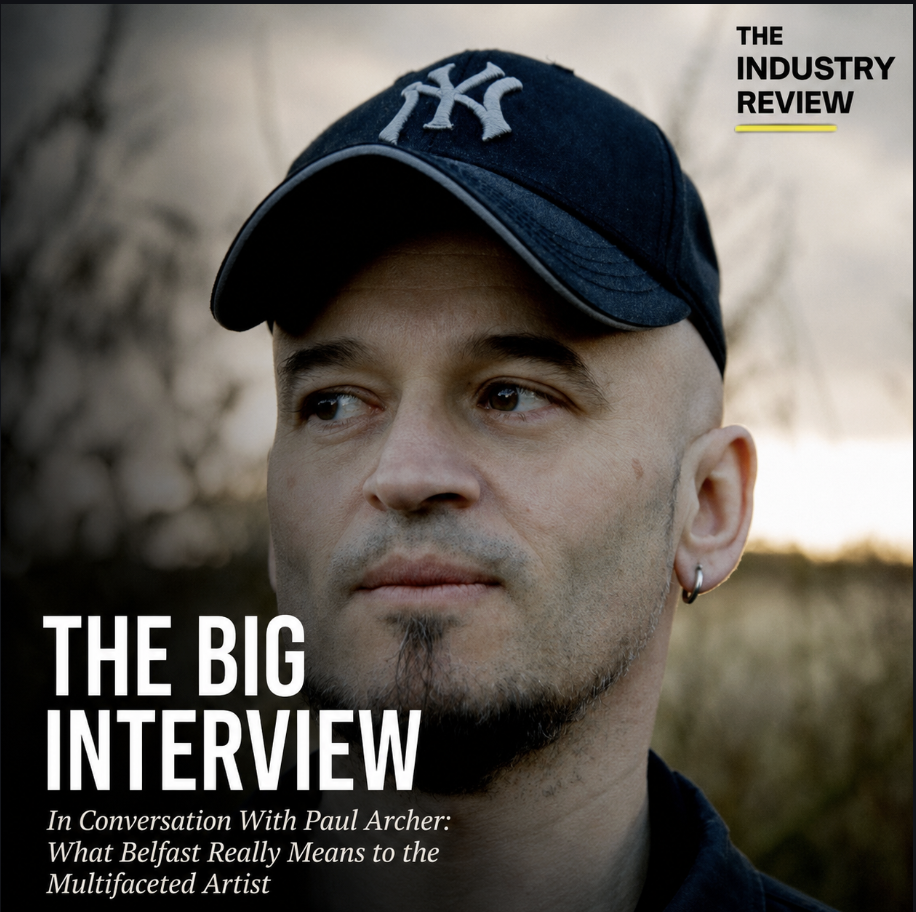
The Belfast musician and visual artist discusses growing up during the Troubles, the radical power of empathy and the city of warmth, wit and creativity at the heart of his new single, ‘Belfast (Place of My Soul)’.
For Paul Archer, Belfast is more than a birthplace. It is a creative force, a spiritual anchor and a city whose people have repeatedly found ways to reach across division. A musician, songwriter and visual artist, Archer first became known on Northern Ireland’s music scene with Disreali Gears, who performed across the city, appeared on UTV’s The Gerry Kelly Show and won Hot Press’s Best Band award for Northern Ireland. His later solo-collaborative project, Burning Codes, continued his pursuit of music rooted in connection, kindness and hope.
Those ideas converge in ‘Belfast (Place of My Soul)’, taken from his current album, Art. Recorded at Start Together Studios in the Oh Yeah Music Centre, the single looks beyond the familiar headlines of conflict and political tension to the Belfast Archer knows: funny, welcoming, complicated and alive with art. It does not romanticise the city or erase its wounds. Instead, it argues that peace is precious, creativity can build bridges and a place should never be reduced to its darkest chapters.

Archer’s perspective has also been shaped by years working in mental health, social care and residential childcare in Ireland and England. That experience gives his belief in healing a practical foundation. Across this conversation, he speaks about music during the Troubles, the people and organisations sustaining Belfast’s cultural life, and why empathy remains his answer to those who would divide communities.
“Despite the headlines, I believe Belfast has incredible kindness and love in its people, and I believe it always will.”
The interview
Belfast has often been defined by its divisions in the eyes of the outside world. Yet ‘Belfast (Place of My Soul)’ paints a very different picture, one rooted in warmth, community and hope. Was it important for you to reclaim the narrative of the city through this song?
Yes, absolutely. As a child of the Troubles, my formative years were coloured by bombs and bullets, enmity between groups, sectarianism, bigotry and the horrific loss of life in this small place. Uncertainty was ever-present in daily life. For me, and for many others, this terrible ordeal seemed never-ending. Peace felt like a pipe dream, always beyond our reach.
During the 1990s, politicians were refusing to engage in dialogue in any meaningful or progressive way. I remember very clearly when Queen’s University Students’ Union approached Disreali Gears, the band I was in at the time. We were fairly well known in Northern Ireland. We had appeared on UTV’s The Gerry Kelly Show, played regularly throughout the city and won the Hot Press Best Band award for Northern Ireland.
The Students’ Union asked us to perform acoustically at political debates it was hosting in an effort to bring the parties into one room and encourage dialogue. We were honoured. I felt it was an opportunity to create some unity through music in a more challenging setting. We played at the beginning and end of each debate, and I still consider those among the most meaningful and worthwhile gigs we ever performed. Those memories influenced this song.
I have always experienced music as a force for connection. In those days, people helped and supported one another. Religion or political persuasion was never an issue for me. It did not come into it then, and it does not now. People are people. We are human beings travelling through life with many of the same dreams and problems. We have more in common than divides us.
The focus was creativity, connection and co-operation. I also remember the force of nature that is Colin Harper, the music journalist, author, songwriter and visionary. He brought together many remarkable Northern Irish bands for his Live at the Warehouse and Live at the Empire compilation CDs, which Disreali Gears were honoured to be part of. Colin was also instrumental in ensuring that ‘Belfast (Place of My Soul)’ appeared on my current album, Art.
My years working in mental health, social care and residential childcare have deepened my belief in empathy and compassion. Coming from Belfast gave me an awareness of trauma-informed practice. While working at a children’s home in England, I was still drawn to write this song. I missed Belfast, its people, art and music, and my memories of home remained incredibly strong.
I was privileged to work alongside inspiring service users, colleagues and children who had endured terrible trauma. I witnessed what felt like miracles as people who had lost hope slowly began to heal. Small moments of empathy, support, kindness and encouragement can gradually reframe the narratives people carry about themselves.
My direction has therefore always been towards empathy, compassion, creativity and connection, and away from sectarianism, racism, fascism and bigotry. Belfast has always been a rich centre of creativity for me, fuelling both my love of music and my belief in the transformative potential of compassion.
The city is home to extraordinary organisations: the Oh Yeah Music Centre, where Gary Lightbody kindly invited me to perform on its opening day alongside artists including Elbow and Lisa Hannigan; the Belfast Community Circus School; Hope Harbour, which supports people experiencing homelessness; and the Starling Collective, which works with refugees fleeing death and torture. There are also the Arts Council of Northern Ireland, which helped fund Art, Late Night Art, Culture Night and the many venues that sustain the arts. I recorded ‘Belfast (Place of My Soul)’ at Start Together Studios in the Oh Yeah Music Centre with Rocky O’Reilly.
The song reflects how I and others lived through the Troubles while trying to keep our minds on positivity and creativity rather than the fear surrounding us. It celebrates the whole city: “I can see it now, from the Shankill to the Falls Road how / The city’s calling out to me, like a beacon in a dark, deep sea.”
Recent headlines have once again focused on unrest and political tension. Having lived through the Troubles and watched Belfast transform over the decades, how difficult is it to see the city reduced to moments that do not reflect the Belfast you know?
It is deeply sad and disturbing to see division and enmity around the city. Recent events, in which people have lost or been driven from their homes, and outbreaks of violence are tragic. I love Belfast, and it breaks my heart to see such suffering.
I also remember times during the Troubles when people from every walk of life and all parts of the city came together through art, music and creativity. They helped one another in a true spirit of co-operation, care and togetherness.
You performed in Belfast during some of its most challenging years, including at Queen’s Students’ Union debates during the Troubles, where music was used to bring people together in deeply divided times. Looking back, did those experiences shape your belief that art can sometimes succeed where politics struggles?
One hundred per cent. Those times were deeply moving and powerful, full of rich creativity and immense co-operation among remarkably diverse people. I remember them with great joy.
We each have a choice about how we live. I choose to keep my eyes focused on the light and on the potentially transformative change created by inclusivity, deep empathy and compassion for one another. We should respect people’s differences rather than choose division. Learning from those differences enriches our knowledge and our understanding of the diverse world in which we live.
One of the strongest messages in ‘Belfast (Place of My Soul)’ is that Belfast belongs to everyone. What would you say to somebody who has never visited and knows the city only through reports of conflict or division?
Belfast has always felt warm to me, despite its perceived divisions. I lived in England for a time and would return to see my family and play gigs with artists and musicians from there. They were repeatedly blown away by how friendly people were. Strangers would simply walk over and chat to them, which was almost unheard of in their experience.
I would say that Belfast, like any city, has its difficulties, but come and experience its vibrant art, music and creativity. One of its great qualities is that people speak to one another in the street. You will hear, “What about ye?” – “How are you doing?” or “What’s the craic?”
The song speaks about gratitude for peace rather than taking it for granted. Do you think younger generations fully appreciate how extraordinary today’s Belfast is compared with the city in which you grew up?
Realistically, it would be difficult to expect younger generations to understand fully how different everything was during the Troubles. However, it is important that none of us forget how much we have to be thankful for, the courage required to bring the present peace to fruition and the many good people from all sides who worked so hard to achieve it.
Peace is very, very precious. It transforms our lives, and we should reflect on that as often as we can.
You describe Belfast as a city built on compassion, creativity and resilience. From the Oh Yeah Music Centre to Late Night Art, open-mic nights and grassroots venues, how important are the arts in continuing to build bridges across communities?
They are utterly essential. The arts are a vital energy and lifeline, with a profound power to transform our lives, thoughts, feelings, connections and perspectives. They enrich, empower and enliven us mentally, physically, emotionally and spiritually.
There is a line running through both your music and your paintings which suggests that brokenness does not have to end in bitterness. Belfast itself feels like an example of that philosophy. Has the city’s journey reinforced your belief that healing is always possible?
Absolutely. I am fascinated by brokenness, whether in visual art or sound. I love the moment when the integrity of a sound wave breaks because it can no longer sustain itself. Suddenly, it unlocks a kaleidoscope of unrealised, previously unheard harmonics, beautiful and unique every time.
There can be transformative healing and joy within what appears broken. Belfast people are down-to-earth and very real. They are not afraid to take the hand out of themselves. Humility and humour can both be incredibly powerful and transformative.
In an era when political rhetoric often encourages people to retreat into opposing camps, your work argues for empathy instead. Do artists have a responsibility to remind us of our shared humanity?
I believe this is central to the reason I am here on this incredible planet. It informs not only my creative work, but every area of my life: mentally, emotionally, spiritually, through my actions and through my faith.
I have a deep connection with the Logos, and I consider the Sermon on the Mount one of the greatest expressions of profound empathy. It continually informs my journey, shifting the focus from our own needs towards those around us: “Blessed are the meek … blessed are the peacemakers … blessed are the poor in spirit.”


You write about Belfast with affection but also honesty. Homelessness, inequality and division remain, yet listeners are left with an overwhelming sense of hope. Was that balance important to you?
Yes. Fundamentally, life is about hope as we experience its chaos and constant change, even within our own minds from one moment to the next. We need only look at how many precious people struggle with their mental health, myself included.
When we shift our focus towards recovery, agency and action, small steps can begin a lifelong path directed by hope rather than labelling or learned helplessness. Belfast people suffered greatly during the Troubles through bereavement, injury and trauma, but we all call Belfast home. Ultimately, I believe more holds us together than separates us.
I try to reflect that in my music and art. Turning towards empathy, compassion, creativity, connection, hope and empowerment can help us transcend hopelessness and uncertainty. It takes courage and time, but we learn along the way. I have witnessed that transformative power many times.
I wrote an entire album about it with Burning Codes, my previous solo-collaborative project. The album was called Rivers of Hope. Another of my songs, ‘Cool to Be Kind’, captures the spirit of putting others first and was written for a homelessness charity.
Belfast fought long and hard to achieve the peace it enjoys today. What would you say to those who seek to divide communities or undermine that peace, and what role can music and the arts play in protecting it?
We are always stronger together. When we come together, we can learn from one another and from our differences rather than trying to hurt or destroy each other. By practising deep empathy, compassion and humility, we enrich our understanding of the world and of ourselves.
Music and the arts can nurture connection and affirm our differences. They can turn our minds, hearts and souls away from enmity and harm, which only destroy our potential, and towards our shared, endless possibilities.
Finally, if somebody hears ‘Belfast (Place of My Soul)’ while forming their first impression of the city, what do you hope they understand about Belfast and the people who call it home?
I wrote ‘Belfast’ for the people, so it would be wonderful if the song resonated with them, even in some small way. I am enormously grateful to everybody who gave their time to be part of it, including Terri Hooley, Laura Hale, Tim Millen, Jon Moorehead, Paul Kane, students from Belfast Metropolitan College, Nathan Connolly, Iain Archer, Jonny Woods, Mark Adair and Monty Sneddon, among others.
I would be delighted if people felt it reflected something of their lives, hopes, dreams and love for Belfast. Honestly, creating this song about my home has been my proudest feeling as an artist. Belfast, for me, is the best city in the world.
Belfast has seen its fair share of Troubles, but it is a city of creativity, great art, music, warmth and enduring hope. Despite the headlines, I believe Belfast has incredible kindness and love in its people, and I believe it always will.
Love and light to the people of Belfast. My hope is that the city will become an ever-brighter beacon of both.
You can find out more about Paul Archer here.
Words: Kieran O’Brien
Leave a Reply