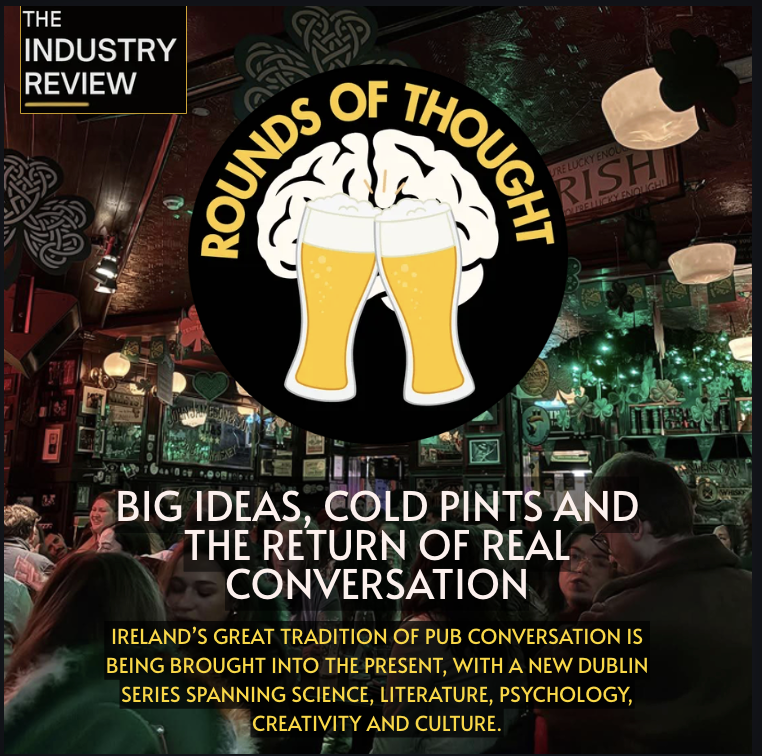
A new Dublin event series is taking neuroscience, literature, creativity and psychology out of the lecture hall and putting them where Irish people have been debating everything for centuries: around a pub table.
There is something very Irish about attempting to solve the problems of civilisation over a pint.
Long before podcasts, TED Talks and people arguing with strangers in comment sections, the pub was one of the places where ideas were exchanged in Ireland. Politics, literature, sport, philosophy, gossip and whatever scandal had broken that particular week all received roughly equal billing.
A new Dublin event series, Rounds of Thought, is tapping into that tradition, bringing academics, writers and creative thinkers into a deliberately informal setting for a month of conversations spanning neuroscience, democracy, Irish literature, neurodiversity, creativity, memory and misinformation.
The premise is refreshingly uncomplicated.
Put down the phone. Pull up a chair. Listen to somebody who knows an extraordinary amount about something. Ask questions afterwards. Have a drink if you fancy one. Talk to the people around you.
No conference lanyard required.
Launching in Dublin this September, the first Rounds of Thought programme brings together four very different speakers across four Tuesday evenings.
Shane O’Mara: How Our Minds Shape Each Other

The series opens on Tuesday, 1 September with neuroscientist Professor Shane O’Mara, Professor of Experimental Brain Research at Trinity College Dublin.
O’Mara’s talk asks a rather timely question: can societies learn before a crisis forces them to?
Drawing on neuroscience and psychology, he will explore how individual minds become collective decisions, why groups sometimes make spectacularly poor ones, and what understanding the brain might teach us about creating more resilient societies.
Central to the discussion is O’Mara’s idea of the “Cognitive Republic”, a framework for thinking about how societies might become smarter, fairer and better equipped to deal with complexity.
At a point when public debate can frequently resemble several hundred people shouting simultaneously into their phones, an evening examining how we actually influence one another’s thinking feels particularly well timed.
Chris Morash: Did Pubs Almost Kill Irish Literature?

Then comes perhaps the most wonderfully provocative title of the programme.
On Tuesday, 8 September, Professor Christopher Morash, Seamus Heaney Professor of Irish Writing at Trinity College Dublin, asks:
Did pubs almost kill Irish literature?
Ireland has spent generations romanticising the relationship between writers and pubs. The image is practically part of the national furniture.
But Morash intends to complicate that mythology.
His talk examines the relationship between Dublin’s famous pub culture and its literary history, including the uncomfortable parts of the story: exclusion of women, excessive drinking and the possibility that the same culture celebrated for nurturing creativity could also constrain it.
That makes the choice of setting particularly clever.
An audience sitting in a Dublin pub will effectively be examining the cultural mythology of the Dublin pub from inside one.
Morash, a Member of the Royal Irish Academy and author of Dublin: A Writer’s City, is particularly well placed to start that row.
And yes, there will presumably be pints available while everyone considers whether pints nearly destroyed Irish literature.
Ireland remains undefeated.
Aoife Dooley: Finding Your Voice Through Humour and Honesty

On Tuesday, 15 September, the focus shifts from cultural history to creativity and neurodiversity with Dublin writer, illustrator, comedian and graphic novelist Aoife Dooley.
Dooley will explore how being autistic has shaped her creative life and how understanding her neurodivergence changed the way she approached her work.
Her bestselling Frankie’s World series draws partly from her own experiences growing up autistic, turning experiences that were once difficult to understand into stories that have connected with readers internationally.
Her Rounds of Thought appearance will look at creativity, identity, stereotypes and what happens when somebody stops trying to see or communicate with the world in the way they have been told they are supposed to.
It also broadens the ambition of the series.
These aren’t simply academic lectures transplanted into a pub. Rounds of Thought is bringing different kinds of knowledge into the same space: scientific, academic, cultural and lived.
Ciara Greene: Why Forgetting Might Actually Be Your Superpower

The September programme concludes on Tuesday, 22 September with Professor Ciara Greene, Professor of Psychology at University College Dublin and head of its Attention and Memory Laboratory.
Greene’s subject is something most of us become increasingly familiar with every time we walk into a room and forget why we’re there.
Forgetting.
Except forgetting, Greene argues, isn’t necessarily evidence that the machinery is failing.
Her talk will explore why forgetting may actually be one of the brain’s strengths, allowing us to adapt, reconstruct experience and navigate a constantly changing world.
There is a darker side to that flexibility.
Human memory is not a perfect recording system. Memories can be reconstructed and distorted, leaving us vulnerable to false memories, misinformation and disinformation.
In 2026, when manipulated information can travel around the world before somebody has finished checking whether it is true, understanding how memory and belief actually work is considerably more than an interesting psychological exercise.
Put Down the Phone, Pull Up a Chair
What makes Rounds of Thought interesting isn’t simply the calibre of its first speakers.
It’s the decision to rethink where these conversations belong.
Public intellectual life has become increasingly mediated through screens. We watch clips, listen to podcasts, scroll through arguments and occasionally type furious responses to people we have never met.
Something is lost when conversation becomes content.
The pub, at its best, offers something completely different: proximity.
You can disagree with somebody and still be sitting beside them ten minutes later. You can ask the speaker the question yourself. Somebody at the next table can make a point you hadn’t considered. A formal talk can turn into an informal conversation long after the microphone has been switched off.
Ireland certainly doesn’t need another excuse to go to the pub.
But an excuse to talk to one another properly while we’re there?
That might be worth pulling up a chair for.
Rounds of Thought: September 2026
1 September: Professor Shane O’Mara, How Our Minds Shape Each Other
8 September: Professor Christopher Morash, Did Pubs Almost Kill Irish Literature?
15 September: Aoife Dooley, Finding Your Voice Through Humour & Honesty
22 September: Professor Ciara Greene, Why Forgetting Might Actually Be Your Superpower
All four events take place in Dublin 2, with talks followed by audience Q&A.
See www.roundsofthought.com for more info
Leave a Reply