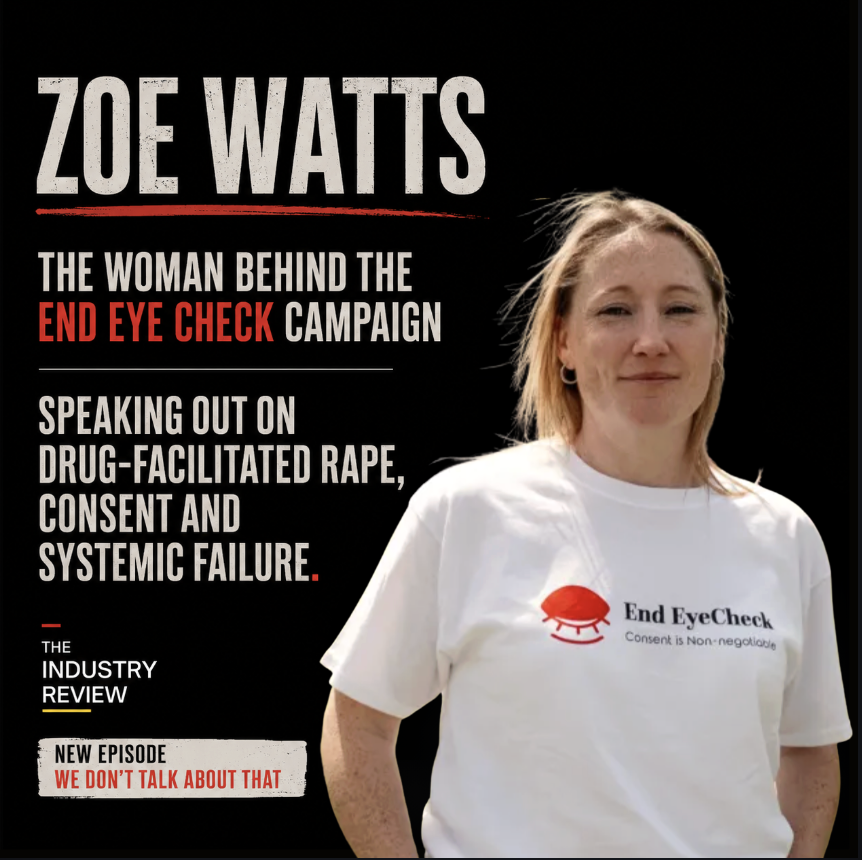
Zoe Watts speaks to We Don’t Talk About That about drug-facilitated rape, the violence hidden inside intimate relationships, and why End Eye Check is pushing for structural change.
Content warning: This article discusses rape, domestic abuse, coercive control and drug-facilitated sexual assault.
For decades, women have been taught to understand danger as something waiting outside the home. Watch your drink. Hold your keys. Text when you get home. Don’t walk alone.
What happens when the person you need protecting from is already inside the house?
That question sits at the centre of the latest episode of We Don’t Talk About That, where we are joined by Zoe Watts, survivor, advocate and co-founder of End Eye Check. Watts waived her anonymity after her former husband was convicted and sentenced to 11 years in prison after drugging and raping her while she was unconscious, and photographing and filming some of the assaults.
For Watts, one of the most difficult parts was recognising what had happened to her as rape at all.
“When it happened to me… it’s something that I had never heard before. I don’t think I’d ever read anything, and my education never described that this was a possibility.”
Our cultural understanding of rape still relies heavily on the stranger, the dark street, the sudden attack. Watts was dealing with something entirely different. The perpetrator was her husband, the violence took place inside an established relationship, and she was unconscious.
She recalled people asking: “If you weren’t awake and you didn’t know, was it a problem?” It was a police officer who eventually stated the obvious to her: “If you can’t consent, it is rape.”
This is also where the language surrounding this form of abuse becomes important.
Watts is unequivocal: “We need to establish that rape is not kink. Like full stop.”
During the interview, she described the extraordinary excuses women have heard from husbands and partners after discovering they had been sexually assaulted while sleeping.
“One man said that I was just so beautiful that he just couldn’t help himself. I looked so peaceful sleeping, he didn’t want to disturb me.”
Others were blamed for being insufficiently sexual, too sexual, not kinky enough or supposedly too kinky.
“Maybe I wasn’t having enough, which made him take what he thought he deserved. I mean, we really can’t win.”
Watts rejects any suggestion that these men simply fail to understand consent.
“I don’t think these men lost the memo. I think they read that memo, and they learnt how to manipulate the system.”
“They know damn well what it is they’re doing.”
Her account also exposes how easily responsibility can migrate from perpetrator to victim.
She remembers being told: “But he’s a good man. Do you really wanna ruin your family over this?”
Her response now is painfully clear: “As if I was ruining the family if I went ahead and prosecuted, rather than he’s ruined the family ’cause he’s been drugging and raping me.”
Even in court, Watts says her previous consensual sexual behaviour became material through which her credibility could be challenged.
“If I slept naked, did it mean that it was my fault?”
“Let’s just say I also wore red lipstick and a short skirt and knee-high boots. Did that mean that it was okay and acceptable?”
The answer should not require debate.
Consent to sex once is not consent forever. Marriage is not consent. Sexual history is not consent. An unconscious woman cannot consent.
The scale of what Watts subsequently discovered transformed her experience from what she once considered an isolated crime into part of something international. End Eye Check has now had engagement from survivors across 55 countries.
The campaign takes its name from the practice of lifting the eyelid of a sedated woman before sexually assaulting her, something Watts wants far more people to recognise and understand.

Her ambitions for End Eye Check go beyond awareness.
Watts wants accurate recording of drug-facilitated rape by police and medical institutions, education programmes in schools and colleges, a functioning nonprofit organisation and specialist survivor support networks.
Without the data, she argues, there is no meaningful picture of the scale.
“When we have statistics, that equals funding. Funding equals money for education programs.”
There is another thread running through our conversation with Zoe that deserves attention too: what happens after survival.
Her recovery has been slow. She speaks openly about dissociation, physical illness, the consequences of prolonged trauma and the years spent creating safety for her children before beginning to process what had happened to her.
But she repeatedly returns to one word.
Joy.
“He’s just not gonna take my joy.”
“I’ll take the fuel of what he’s done to me and use it to turn it into something good.”
That is perhaps where the episode ultimately lands.
Not with another demand that women become better at avoiding rape, but with a demand that institutions, educators, police, healthcare systems and society become considerably better at recognising what rape can actually look like.
And at listening when women tell us.
The Industry Review is supporting We Don’t Talk About That across its networks. The full episode with Zoe Watts and End Eye Check is available now.
Leave a Reply