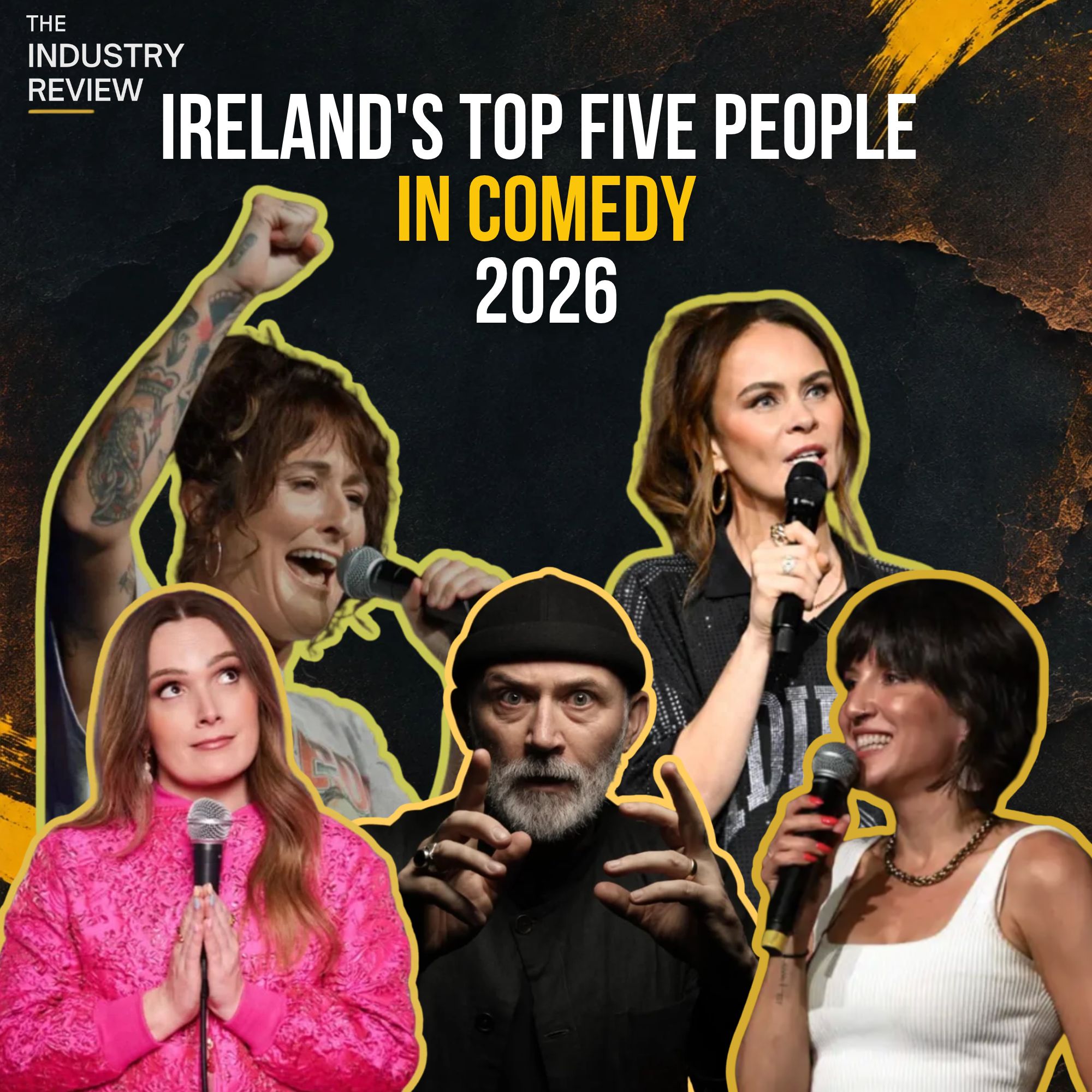
From Joanne McNally’s historic arena success to Kyla Cobbler’s extraordinary rise and Aoife Dunne’s deeply personal storytelling, The Industry Review celebrates five performers who helped shape Irish comedy in 2026. This year four out of our Top 5 just happen to be women!
Ireland has long regarded comedy as something close to a national instinct. We have a gift for finding humour in the most hopeless circumstances, making a story out of an ordinary encounter and refusing to take ourselves too seriously. For generations, comedy has helped us examine everything from religion and politics to family life, social class and the peculiar business of being Irish, with all its eccentricities.
The country’s comedy industry, however, has undergone an extraordinary transformation. The traditional route through television, radio and established comedy clubs is no longer the only way to build a substantial career.
Social media has opened new doors, podcasts have created loyal communities, and Irish performers are selling tickets internationally without waiting for the approval of conventional entertainment gatekeepers who historically preferred to choose men.
Women are central to this change. Their success is not confined to one style of comedy or one generation of performers. From arena-filling stand-up to intimate accounts of grief, relationships and personal reinvention, they are demonstrating just how broad the possibilities of Irish comedy have become.
The Industry Review’s Top Five People in Comedy for 2026 celebrates performers whose work reflects artistic originality, cultural influence, audience connection and professional achievement.
1. Joanne McNally: The Woman Rewriting the Irish Comedy Rulebook
Joanne McNally takes the top position following a remarkable year that has seen her career expand across Ireland, Britain and the United States.
Her Pinotphile tour has brought her to the largest stages in Irish comedy. With four performances scheduled at Dublin’s 3Arena in December 2026, McNally has achieved a level of live demand that would once have seemed extraordinary for an Irish stand-up comedian.
In October, she made her American late-night television debut on The Tonight Show Starring Jimmy Fallon, receiving a standing ovation. Her forthcoming Netflix special, filmed in New York, is another major step in her international career.
Yet McNally’s appeal is about considerably more than ticket sales. Her comedy explores relationships, personal insecurities, social expectations and the contradictions of contemporary womanhood. She has built an audience through her willingness to discuss experiences that previous generations of women were frequently encouraged to keep private.
Her success also challenges a stubborn assumption within entertainment that female comedians must soften their material or make themselves more agreeable to attract mainstream audiences. McNally has built her career with an unapologetic voice and an extraordinary command of the room.
In 2026, she is not simply one of Ireland’s most successful female comedians. She is one of the country’s most commercially significant comedians, full stop.
2. Kyla Cobbler: The International Breakout Star
Few Irish comedians have experienced the kind of momentum Kyla Cobbler has enjoyed.
The Cork-born, London-based performer has developed an international following through a combination of sharp observational humour, uncompromising honesty and an instinctive understanding of digital audiences.
Her Not My Lemons tour began with 16 Irish performances before expanding to 36, all of which sold out. She is now preparing to headline Dublin’s 3Arena in February 2027, an extraordinary development in a career that has grown at considerable speed.
Cobbler’s comedy draws on dating, relationships, Irish identity, everyday frustrations and the absurdity of modern social expectations. Her delivery feels conversational, spontaneous and gloriously unfiltered. There is little distance between the person audiences encounter online and the performer they see on stage.
What makes her rise especially interesting is how she has developed a substantial live career through an audience that first encountered much of her work digitally.
Social media can produce enormous visibility without necessarily establishing a sustainable career. Cobbler has demonstrated an ability to convert that attention into ticket sales, filling theatres and expanding into considerably larger venues.
Her success reflects a changing comedy business in which performers can develop their own audiences, establish their identities and move beyond the traditional routes into television and broadcasting.
For The Industry Review, Cobbler is one of the defining breakout stories of Irish comedy in 2026.
3. Tommy Tiernan: The Enduring Master of Irish Comedy
Tiernan occupies a distinctive position within Irish entertainment. His comedy has always drawn on the traditions of storytelling, philosophical curiosity, religious imagery and the unpredictability of human behaviour.
His influence extends well beyond the stand-up stage.
Alongside his acclaimed RTÉ television series, he reunited with longtime friend Hector Ó hEochagáin and fellow presenter Laurita Blewitt for the return of The Tommy, Hector & Laurita Podcast in September 2026. The show’s free-flowing conversations, irreverent humour and unmistakable chemistry celebrate a distinctly Irish tradition of storytelling.
Its return adds another dimension to a career that continues to reach audiences across live performance, broadcasting and digital media.
His television work has introduced another dimension to his public identity. By interviewing guests without advance knowledge of their identities, he has created a format in which uncertainty becomes part of the conversation.
The programme has also demonstrated how humour can coexist with serious discussions about identity, personal experience, creativity and mortality.
Tiernan’s inclusion recognises the value of artistic longevity in an industry increasingly shaped by digital visibility and rapidly changing audience habits.
New performers are transforming the business, but experienced artists continue to demonstrate the importance of craft, curiosity and the ability to connect with audiences across generations.
His contribution to Irish comedy remains substantial.
4. Emma Doran: The Unmistakable Voice of Modern Irish Womanhood
Emma Doran has developed an impressive career by turning ordinary experiences into comedy that resonates with audiences across Ireland and Britain.
Her Emmaculate stand-up tour continued throughout 2026, with additional performances reflecting sustained demand for her work. Alongside live comedy, she co-hosts the Keep It Tight podcast with Deirdre O’Kane and has established herself as an author and digital performer.
Doran’s appeal lies in her ability to recognise the humour within experiences that are often dismissed as mundane.
Motherhood, family relationships, ageing, dating, domestic life and the contradictory expectations placed upon women all provide material for her comedy.
Her observations are accessible without being simplistic. She understands that a familiar situation can become extraordinarily funny when someone finally describes it with enough accuracy.
There is also a wider cultural significance to her success. For decades, women’s experiences within mainstream comedy were frequently filtered through male perspectives or presented as material of limited interest. Doran’s work challenges that assumption by treating women’s lives as an endless source of comedy in their own right.
Her continued success in 2026 reflects the strength of an audience that recognises itself in her writing and performances.
5.Aoife Dunne: Finding Laughter in the Aftermath of Loss
Comedy has always offered a way of making sense of difficult experiences. Few emerging Irish performers have explored that possibility with the emotional depth of Aoife Dunne.
Her acclaimed debut show, Good Grief, examines the death of her mother when she was 23 and the years that followed, combining stand-up, poetry and personal storytelling.
The show has attracted audiences across Ireland and Britain, selling out performances and securing an extended tour into 2027.
Dunne is an unusual presence in contemporary comedy. Her work does not rely on the constant delivery of punchlines. She allows vulnerability, sadness, reflection and humour to occupy the same space, recognising that people can experience several contradictory emotions within a single moment.
There is considerable artistic confidence in that approach.
Irish culture has a complicated relationship with grief. We have elaborate traditions surrounding death, yet speaking openly about its lasting psychological and emotional consequences can remain difficult. Dunne approaches those experiences with tenderness, irreverence and a remarkable willingness to expose her own uncertainties.
Her emergence also shows us that audiences are hungry for forms of comedy that move beyond familiar formulas. Personal storytelling, when handled with originality and skill, can have enormous theatrical power.
At No. 3, Aoife Dunne represents one of the most compelling new voices in Irish performance, bringing an important and distinctive perspective to the national comedy landscape.
A Comedy Industry Finding New Voices and New Audiences
These five performers represent different generations, artistic approaches and routes to success. Together, they offer a fascinating picture of the Irish comedy industry in 2026.
Joanne McNally is establishing new commercial possibilities for Irish stand-up. Kyla Cobbler has shown us the potential of digitally developed audiences. Tommy Tiernan continues to connect traditional storytelling with modern entertainment, while Emma Doran has built a substantial career around the humour of everyday experience. And Aoife Dunne is expanding the emotional and theatrical vocabulary of comedy.
Four of the five performers selected this year are women. Their presence reflects this editorial assessment of the talent, originality and career achievements shaping Irish comedy, not a claim that the wider industry has achieved gender equality.
There are still important questions surrounding access to opportunities, the economics of live performance, representation and who gets to build a sustainable career in comedy.
Yet the work of these artists proves that Irish audiences are receptive to an increasingly diverse range of comic voices.
For an art form that has always relied upon challenging assumptions, that is a development worth celebrating.
An independent editorial selection recognising artistic achievement, cultural influence, originality and audience impact throughout 2026. All Images from Instagram.
Leave a Reply