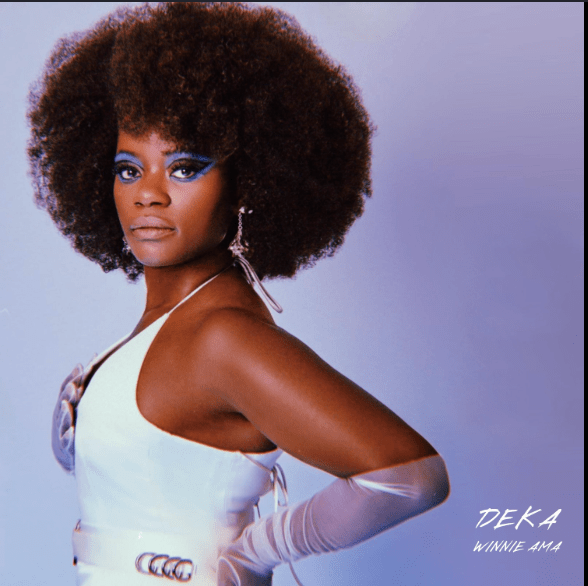
On her debut album, the Northern-Irish-Ghanaian artist moves confidently through soul, disco, electronic pop and folk, creating a record about desire, identity, community and choosing light without denying the darkness.
Artist: Winnie Ama
Album: DEKA
Label: WAMA Music
Rating: ★★★★½
There is something quietly defiant about an artist refusing to choose between the different parts of herself.
The music industry adores a tidy category. It wants the pop singer, the soul vocalist, the electronic artist or the earnest songwriter. Preferably one at a time, thank you very much, because somebody in marketing has a playlist to pitch before lunch.
Winnie Ama’s debut album, DEKA, has little interest in that kind of neatness.
Across its fourteen tracks, the Northern-Irish-Ghanaian artist moves between disco, electronic pop, soul, R&B and folk without presenting any of them as a costume. These sounds belong together because they belong to her. The result is not an album desperately searching for a genre. It is an artist confidently establishing the breadth of her musical identity.
The title provides the key. Deka means “one” in Ewe, her mother’s native language from Ghana. It represents unity, creativity through difference and the fact that this is Ama’s first complete body of work. It is a simple word carrying several histories at once.
That idea of many experiences forming one identity runs throughout the album. Ama does not divide life into the presentable and the painful. Romance, lust, friendship, betrayal, belonging, forgiveness and self-possession all occupy the same emotional landscape.
In Ama’s own words, the album is about “choosing light without pretending the rain didn’t happen”. It is a fine description of the record’s emotional intelligence. DEKA is joyful without becoming oblivious and hopeful without insulting the listener with empty affirmations.
Opener ‘Don’t You Want It?’ establishes the album’s confidence immediately. Desire belongs firmly to Ama here. She is not waiting to be selected, pursued or granted permission to express what she wants. Her vocal is warm and inviting, but the song’s central energy comes from directness. She asks the question while making it abundantly clear that she already knows her own answer.
That bodily confidence continues through ‘Fever’ and ‘Get on You’. ‘Fever’ captures the point at which music, attraction and movement become inseparable. The club is not merely a location. It becomes a physical state, with the song’s pulse reflecting the rush of allowing rhythm to override caution.
‘Get on You’ is more playful and openly assertive. Its cat-and-mouse language reverses the dreary pop tradition in which women are expected to be desirable without ever sounding too certain of their own desire. Ama does not hover prettily at the edge of the song. She drives it.
This sensuality never feels manufactured for effect. There is humour in it, as well as agency. Ama understands that seduction can be fun, ridiculous and gloriously lacking in dignity. Pop music could do with remembering that more often.
The sequencing also prevents DEKA from becoming trapped in a single emotional temperature. ‘No Good’, ‘So Good’ and ‘What You Trying to Do?’ sit within the album’s exploration of attraction and uncertainty, where pleasure, suspicion and emotional negotiation are rarely separated for long.
It is in the quieter moments, however, that the record’s deeper architecture becomes apparent.
‘Sun Follows Rain’ examines the end of a relationship with notable restraint. There is no villainous ex conveniently set on fire for the chorus. Instead, Ama writes about two people recognising that love can remain even when a relationship has become unsustainable.
The song acknowledges the fear involved in letting go while resisting the temptation to mistake suffering for proof that a relationship should continue. Its central image is simple but effective: rain does not invalidate the existence of sunlight, and heartbreak does not erase the love that preceded it.
That understanding of emotional contradiction is one of Ama’s strengths as a songwriter. She is capable of writing from inside desire without pretending it will necessarily last. She can recognise damage without constructing an identity around being damaged.
‘Wide Open’ moves into more exposed territory. The song is built around the frightening imbalance created when one person offers trust and the other is not prepared to receive it. Ama’s performance conveys the paralysis of knowing that love is available while simultaneously fearing what accepting it might demand.
It would be easy to bury that vulnerability beneath oversized production. Instead, the song gives the vocal and lyric enough room to breathe. Ama’s soulful delivery carries the emotional hesitation without theatrical overstatement.
‘Tangled’ offers another side of romantic surrender. Where ‘Wide Open’ fears emotional exposure, ‘Tangled’ embraces it. The song is unabashedly affectionate, filled with the slightly embarrassing sincerity that arrives when somebody has knocked all the cool out of you.
Ama knows the language is sweet. That is part of its charm. She does not protect herself with irony or pretend emotional distance makes a person more sophisticated. Sometimes love makes intelligent adults sound like cards in the Valentine’s aisle, and there are worse crimes.
Elsewhere, tracks including ‘Everywhere’, ‘Run Away’, ‘Daisies’, ‘Only’ and ‘Dive’ broaden the album beyond a straightforward chronology of romance. The record considers identity, community and the relationships that hold us together when romantic love proves unreliable.
‘Daisies’ is particularly significant within that wider emotional world. Its warmth feels earned rather than decorative, carrying the album’s recurring belief that hope is not the absence of pain but a decision made after encountering it.
The album was developed with an international group of producers, including Simon Le Saint, Yacine Alaoui, Jonny Parry, Greg Hummell and David Goode. That range of collaborators contributes to its global musical character. Yet the project does not feel anonymous or assembled by committee. Ama’s voice, both literally and artistically, remains the connecting thread.
That voice has been shaped by multiple traditions. Ama draws inspiration from Ella Fitzgerald, Billie Holiday and Nina Simone, artists for whom vocal ability was never separate from interpretative intelligence. There are also traces of gospel, disco, contemporary electronic music and alternative R&B throughout her work.
The inheritance is audible without becoming imitation. Ama has the technical control to sing with considerably more ornamentation than she often chooses to use. Her restraint serves the songs. She understands when to push, when to soften and when a clear melodic line can communicate more than a small Olympic event involving vocal runs.
Her Northern Irish and Ghanaian identities are not presented as competing claims. Nor are they reduced to a branding exercise about being “between two worlds”, a phrase applied far too casually to mixed-heritage artists. DEKA is interested in integration rather than division. Its perspective is formed by both histories and diminished by neither.
That carries particular weight within an industry where Black Irish artists still encounter limited expectations about what their music should sound like and which parts of their identity audiences will supposedly understand.
Ama does not simplify herself for that audience. She trusts listeners to follow her from the dance floor into heartbreak, from electronic production into folk influence, and from romantic intimacy into questions of belonging.
The album’s occasional unevenness is largely a consequence of its ambition. Fourteen tracks spanning several genres will not produce complete sonic uniformity, and some transitions are more natural than others. At times, the mixtape structure feels more accurate than the traditional album label, with each song operating as a distinct chapter rather than every track serving one rigid sound.
But that is also central to DEKA’s purpose. Unity is not uniformity.
The album does not argue that every part of life can be made seamless. It suggests that contradiction itself can become a coherent identity. Pleasure and grief can coexist. Independence does not eliminate the need for love. Forgiveness does not require amnesia. A woman can be sensual, political, vulnerable, ambitious and joyful without any of those qualities cancelling the others.
Winnie Ama has already built an impressive live reputation, opening for Macy Gray, Sister Sledge and Cymande, earning recognition from BBC Introducing and performing internationally. Her artistic reach has now extended considerably beyond the independent music circuit.
Ama appears in DC Studios’ 2026 feature film Supergirl, starring Milly Alcock, in the credited role of the Evely Band Singer. She performs on screen, while her song ‘What Are We’ also features in the film. For a Northern-Irish-Ghanaian independent artist, appearing in a major Warner Bros. and DC Studios production represents a remarkable leap in visibility, placing her voice inside one of the world’s largest entertainment franchises.
That achievement also strengthens the significance of DEKA. This is not an artist being briefly introduced before the industry moves on to somebody newer. Ama is already building a career across records, international stages and cinema.
DEKA explains why those opportunities have followed. Beneath the charisma is a thoughtful songwriter with a firm grasp of melody and a clear sense of artistic purpose.
Most importantly, this debut sounds like a beginning rather than a summary.
Ama has not used DEKA to present a perfectly resolved version of herself. She has created a generous, danceable and emotionally honest record about becoming whole without sanding away the complicated parts.
There is rain here. There is betrayal, uncertainty and fear. But there are also bodies moving, friendships enduring, identities meeting and a woman choosing to remain open to pleasure.
The light does not erase what happened in the darkness. It simply means the darkness did not get the final word.
Verdict: A soulful, sensual and assured debut that turns Winnie Ama’s multiplicity into her greatest artistic strength. DEKA celebrates unity without demanding uniformity, and finds joy without ever pretending that joy comes easily.
Words: Kieran O’Brien

 The Industry Review
Leave a comment