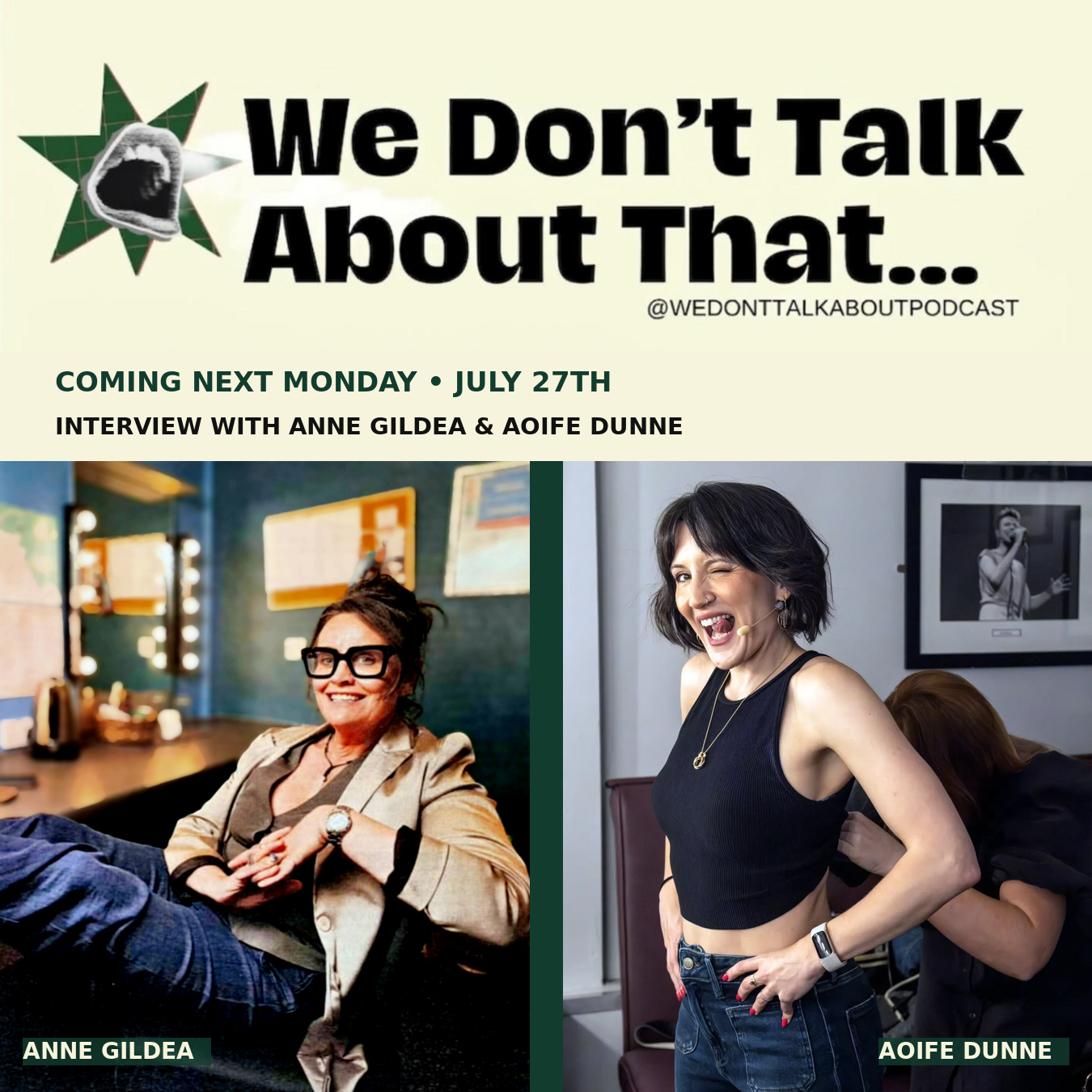
The top Irish comedians join We Don’t Talk About That on Monday for a frank, funny conversation about women’s bodies, silenced grief, industry gatekeepers and refusing to dance for approval.
What happens when women stop approaching the difficult parts of life sideways and begin speaking about them plainly?
On Monday, 27 July, comedians Anne Gildea and Aoife Dunne join Linda Coogan Byrne and guest co-host Ndidi O on We Don’t Talk About That for a conversation about menopause, cancer, grief and the changing position of women in Irish comedy.
It is frequently hilarious, but the laughter is never used to tidy away the difficult parts. Both performers understand comedy as something that can sit alongside pain, not erase it.
Gildea has been performing for almost four decades. A founding member of musical comedy trio The Nualas, she has also built a successful solo career tackling subjects that mainstream entertainment once considered too uncomfortable, too intimate or simply too female.
Her show How to Get the Menopause and Enjoy It began during lockdown, when she initially set out to write about midlife.

“It was my partner, Paul, who said, ‘The title of your show is How to Get the Menopause and Enjoy It’,” she recalls.
“At that time in 2020, I thought, ‘Who wants to hear about menopause?’ But it was so fortuitous and serendipitous that we landed on that topic. By the time lockdown was over, I had the show ready to go. I came out of the traps with it in 2022, menopause was the word du jour, and it just caught a wave.”
Researching the show exposed the depth of what Gildea herself had never been taught about women’s health.
“I really connected to how sidelined women are in everything. I already knew that in showbusiness, but in medicine and everything around menopause and the mystery of it, it felt urgent. It felt urgent as well as something worth talking about.”
Her research also forced her to reconsider her previous experience of breast cancer.
“I went into shock for a few months and realised all that I didn’t know. I didn’t know what was going on with my body. I’d had breast cancer ten years before that and I didn’t realise that I had been in chemical menopause, and that it had affected a lot of things in my life. There was no talk of that at all.”
Gildea was diagnosed with breast cancer in 2011, but says she nearly missed the illness because her symptoms did not match the limited public information she had been given.
“My cancer was quite advanced by the time I went to the doctor because I had a swelling on my breast, but I was going, ‘It’s not a lump.’ That’s all I’d ever heard. Breast cancer is a lump.”

For Aoife Dunne, the silence surrounding grief became the starting point for her show Good Grief.
Dunne’s mother died suddenly when she was 23. For years afterwards, she felt as though she were standing outside her own life, watching everybody else through a shop window.
“I think when you get to a certain age as a woman, you probably just get tired of not talking about things,” she says.
“I knew I needed to tell my story because of what I had learned through grief. I think when people are grieving, they’re going around wearing a heavy coat.”
Dunne believes silence can transform pain into shame.
“I think everything eventually becomes shame if you keep it silent. That’s what I’ve learned about the cycle of shame. Shame is at the end of years of silence.”
The breakthrough came during the pandemic. Her relationship had ended, her usual distractions had disappeared and, after accidentally smoking cannabis on an empty stomach, an initially frightening experience released something she had kept contained for years.
She began writing and asked herself one question: what would be so bad about falling apart completely?
“I had been trying so hard to hold it together and let the world know that I’m strong, that I’m able and that I’ve got this, because this is the language we’ve been taught as women.
“I just went, ‘Okay, let’s fall apart here on the floor of your bedroom, in the wake of this breakup, in the middle of what could be the end of the world.’
“All I did was cry solidly for about three days. Afterwards, I was like, ‘Was that it? Was that my grief?’ I realised sadness wasn’t this horrific thing. Sadness is freeing and cathartic. I was terrified of being sad for nearly 15 years, and as soon as I let myself feel sad, I thought, ‘Right, that’s not that bad.’”
That realisation shaped Good Grief, a show embracing sadness without becoming consumed by it.
“I knew I was going to make a show that was both light and dark because we need both,” Dunne explains.
“I don’t think humour should be used as a way to shield yourself or cover things up. It should be in conjunction with sadness to draw it out. Laughter lives next to it.”
The episode also moves beyond personal experience to examine the changing landscape for women in comedy.
Social media has allowed women to build their own audiences without first being selected by male-dominated comedy clubs, agents or commissioners. Gildea remembers an industry in which male performers were frequently nurtured by teams of women working behind the scenes, while female acts received considerably less support.
“These guys were mollycoddled by teams of women,” she says. “So many times, we didn’t feel supported by professional women.
“Now, women are doing it for themselves. Women can’t be ignored by the agents. They can put it out there themselves. There are no longer the same gatekeepers.”
Dunne acknowledges that the industry has improved, while arguing that female performers are still judged differently, particularly in traditional comedy clubs.
“I’ll see a male performer ahead of me and the men are giving him their full attention. As soon as I step onstage, the arms are folded and they’re turning around to talk to their friends.
“It is more common that I have to work harder than my male peers to make them like me. If there are more men in the club, I have to be funnier. Women have to be funnier than men.”
By contrast, performing her own show means meeting an audience that has actively chosen her work.
“That’s the dream, that you only play to your audience at all times,” she says.
Women now comprise the majority of both comedians’ audiences. They organise nights out, book tickets early and bring other people with them.
Gildea began recognising this shift more than a decade ago.
“I noticed this whole world of older female audiences who wouldn’t necessarily go to a comedy club but do like to go out to theatres for entertainment. There was an amazing audience there that was relatively untapped. I think people have clued into it now.”
The conversation concludes with both women offering blunt advice to performers trying to navigate rejection and industry gatekeeping.
Dunne recalls refusing to beg for approval from venues that expected her to prove herself repeatedly, despite having already sold out Dublin’s 3Olympia Theatre.
“When it comes to women, we’ve been forced to dance a bit more than men,” she says. “Don’t dance for them. If you know you’re good, they’ll find that out for themselves.”
Gildea’s advice is equally direct.
“You don’t have to fit in everywhere. Think about where you’re coming from and what you want to land into the world, and you will find your tribe. Be very careful who you make your peers.”
Dunne will take Good Grief to the Edinburgh Fringe for its final run there this year. Gildea continues touring Further Adventures in Womaning while developing her next show, You’re Welcome, for 2027.
Their conversation is about far more than surviving comedy as women. It is about what becomes possible when women stop treating their bodies, grief and anger as unsuitable material.
The result is an audience laughing, not because the pain has disappeared, but because somebody has finally spoken about it without shame.
The new episode of We Don’t Talk About That, featuring Anne Gildea and Aoife Dunne, will be released on Monday, 27 July. You can listen here.
Leave a Reply