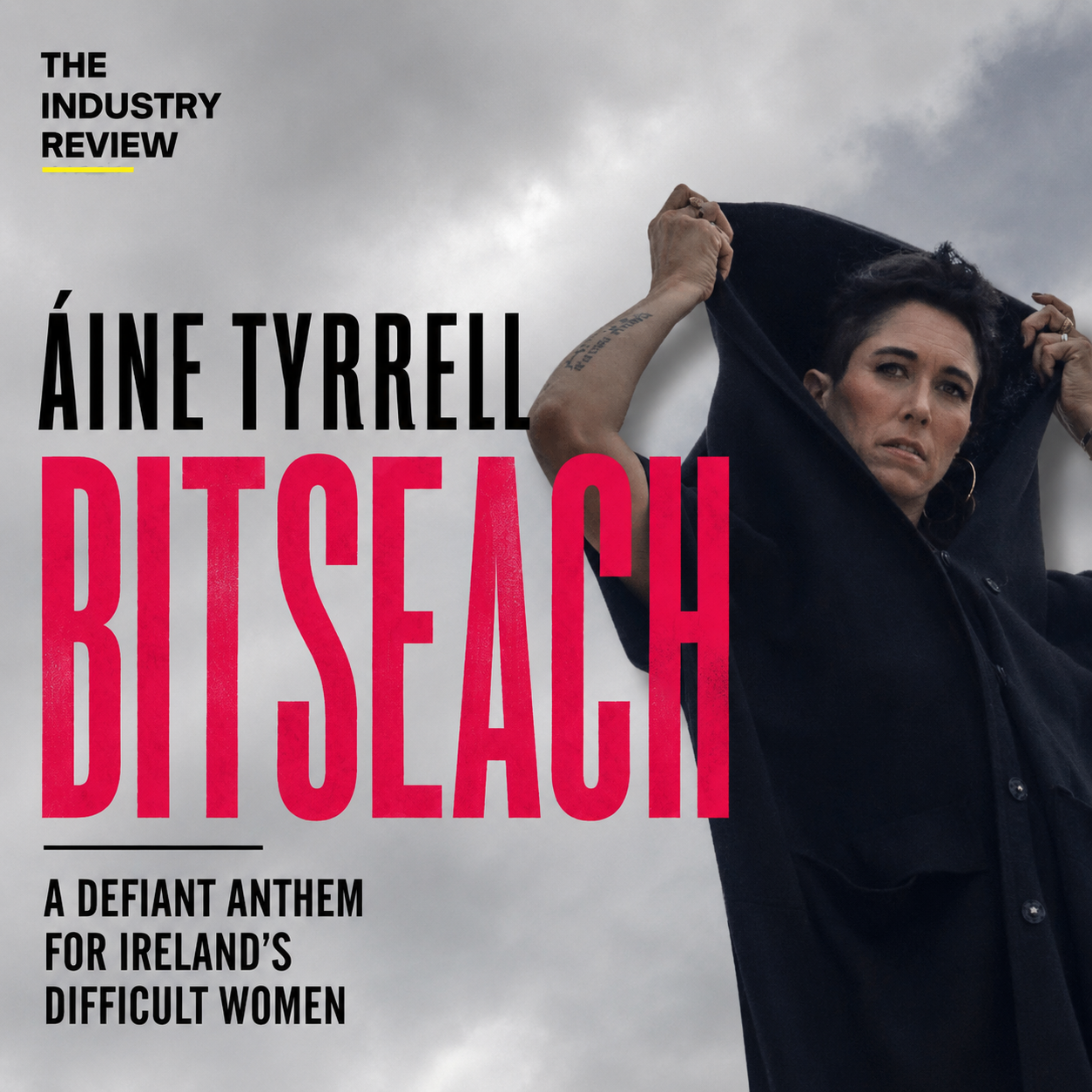
There is something wonderfully insolent about BITSEACH. Áine Tyrrell takes a word intended to put women back in their place and builds a song around the women who refused to stay there.
That distinction is important. This isn’t another vaguely empowering song about being strong. Tyrrell is interested in something far less comfortable: what happens to women who are considered difficult because they speak, resist, refuse, organise or simply decline to behave as expected.
Musically, BITSEACH is equally unwilling to behave itself.
Tyrrell moves between spoken word, rap, electronic production and the cadences of Irish traditional music without trying to tidy any of it into an easily marketable genre. There are moments where something ancient seems to be pushing through a thoroughly contemporary production, and that tension gives the track much of its character.
Her delivery is central to why it works. She doesn’t sing the song from a safe distance. At times she spits the words, at others she seems almost to invoke them. There is humour in there too, alongside anger and pride, which saves BITSEACH from becoming overly solemn. A lesser artist could have turned this subject into a lecture. Tyrrell makes it feel closer to a gathering.
The title itself does a considerable amount of work. Bitseach is the Irish rendering of “bitch”, but here the insult is taken apart and handed back. Tyrrell’s target is bigger than the word itself. Ireland has a long history of finding names for women who stepped outside the boundaries drawn for them by church, state, family and polite society. The troublesome woman. The fallen woman. The mad woman. The difficult woman. The bitch.
BITSEACH asks what happens when she stops trying to prove she is none of those things.
That gives the song a lineage stretching far beyond contemporary pop feminism. Tyrrell has explicitly placed the work in conversation with generations of Irish women who challenged the structures around them, and you can hear that sense of inheritance in the record. It isn’t nostalgia for some romantic version of Ireland. It is an argument with Ireland, made by somebody who clearly loves the place enough to argue with it.
There is also a pleasing refusal to translate everything for the listener. Irish words, rhythms and references are not presented as decorative Celtic flourishes for an international audience. They belong there. Tyrrell makes the listener come towards her instead.
That may be the most compelling thing about the track from an industry perspective. At a point when artists are routinely encouraged to make themselves immediately understandable, searchable and genre-specific, Tyrrell has produced something culturally particular and musically awkward to categorise.
Good.
Irish music has become considerably more interesting internationally when its artists have stopped worrying about making their Irishness palatable. BITSEACH belongs somewhere in that wider movement, but Tyrrell’s voice is distinctly her own. She isn’t borrowing rebellion as an aesthetic. There is too much lived history behind the performance for that.
And beneath all the politics, the record has something more basic going for it: personality. You know who made this song.
That sounds like a small compliment. In the current music industry, it really isn’t.
BITSEACH doesn’t ask whether there is still room for the difficult Irish woman.
It assumes she has already arrived.

Leave a Reply