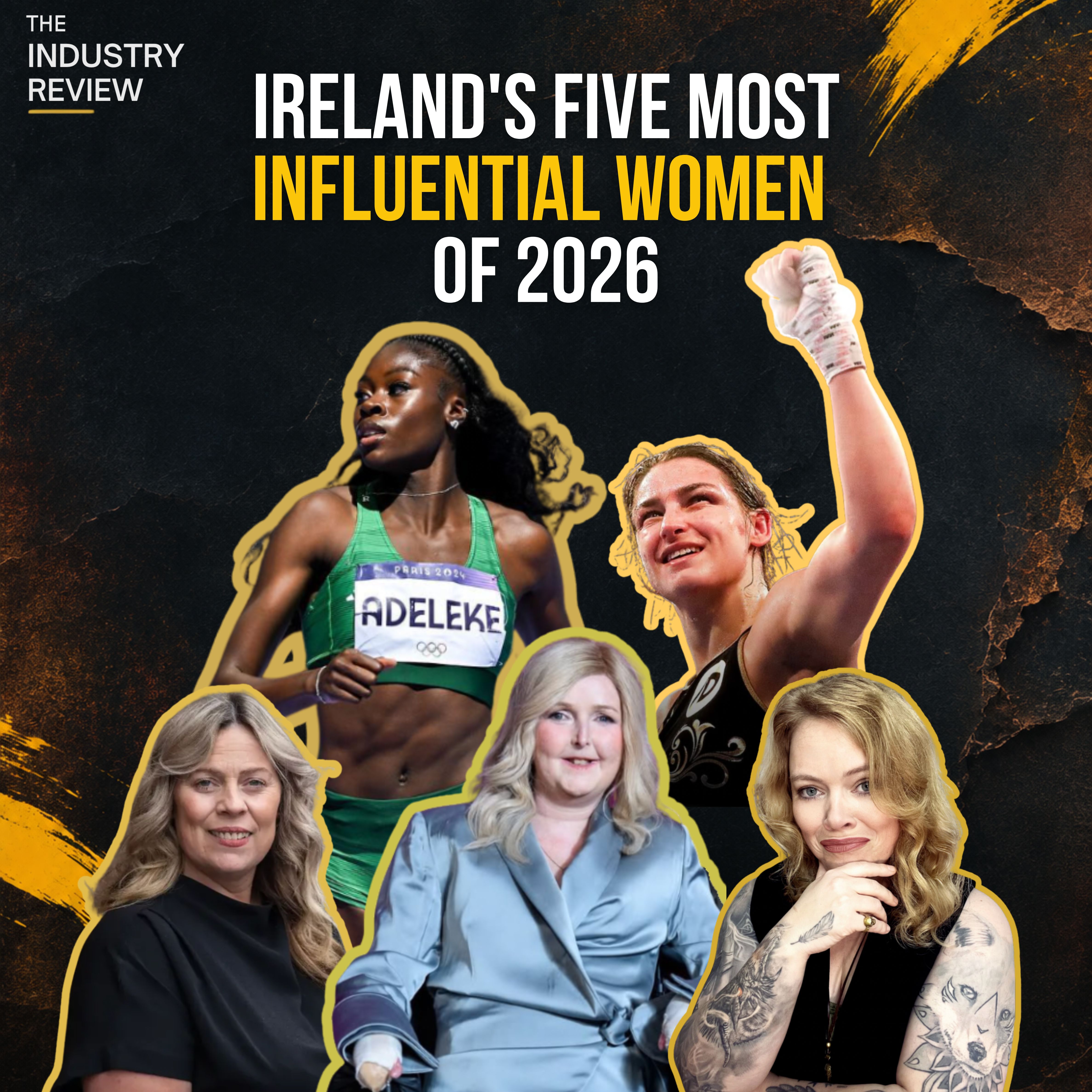
From Katie Taylor’s historic farewell at Croke Park to the women confronting poverty, disability discrimination, inequality in the music industry and barriers in international sport, The Industry Review celebrates five Irish women whose achievements have helped shape the national conversation in 2026.
Ireland has never lacked remarkable women. What it has lacked, historically, is an equal willingness to recognise their contributions, invest in their ideas and acknowledge the changes they have brought about.
For generations, women’s achievements were confined to the margins of national history. Their work in education, cultural life, community organising and social reform was too often celebrated only after the institutions they challenged had finally begun to change. Some were written out of the story altogether.
In 2026, Irish women have continued to challenge those old arrangements. Across sport, literature, disability advocacy and the creative industries, they are questioning institutional authority, creating opportunities and demanding a country that makes room for more of its people.
Our selection brings together five women whose work has made a substantial contribution to Irish public life. Some are internationally recognised figures. Others have spent years building campaigns without the financial resources, political connections or publicity machinery available to established institutions.
Their achievements are different, and influence cannot sensibly be measured through a single set of criteria. Medals, books, academic research, campaigning and institutional reform all leave different marks on society.
This is not a numerical ranking. It is an editorial selection of five women whose achievements deserve recognition, not simply for what they have accomplished personally, but for the opportunities their work has helped create for others.
Katie Taylor: The woman who changed boxing and gave Ireland a farewell for the history books

On 5 September 2026, Katie Taylor walked into Croke Park for the final professional fight of her career. More than 80,000 people had gathered to watch one of Ireland’s greatest sporting figures bring an extraordinary chapter to a close.
By the end of the evening, Taylor had defeated France’s Flora Pili by unanimous decision, becoming a three-time undisputed world champion before retiring from professional boxing.
It was an occasion that would once have been almost unimaginable for a female boxer in Ireland. The country’s most celebrated sporting arena had become the setting for a woman whose career had transformed expectations of what women’s boxing could achieve.
Taylor’s importance extends far beyond her remarkable collection of titles.
When she began competing, women’s boxing occupied a very different position within international sport. Female athletes faced limited opportunities, inadequate investment and a prevailing assumption that audiences would never support women’s contests on the same scale as men’s.
Taylor spent much of her early career helping challenge those conditions. She became a five-time world amateur champion and won Olympic gold at London 2012, the first Games to include women’s boxing.
Her subsequent professional success helped establish women’s boxing as a major commercial attraction. Her contests against Amanda Serrano became landmarks in the sport, demonstrating the enormous public appetite for elite female competition when it received meaningful investment and promotion.
The Croke Park farewell represented the culmination of that journey.
There is a tendency to describe successful sportswomen as inspirational without examining the conditions that made their achievements difficult in the first place. Taylor undoubtedly possesses exceptional technical ability, determination and competitive intelligence. Yet her career also demonstrates how much sporting potential can be constrained by the structures surrounding it.
Her success did not prove that inequalities in women’s sport were imaginary. It exposed the limitations of the assumptions that had sustained them.
By September 2026, Taylor had become one of the most recognisable athletes in Irish history. The size of the Croke Park audience provided a remarkable answer to anyone who had previously questioned the commercial viability of women’s boxing.
The occasion also generated an extraordinary television audience. RTÉ’s coverage reached approximately 1.6 million viewers, according to reporting published following the fight. The Irish Times
Two months later, Taylor was named Irish Tatler Woman of the Year 2026, another distinction recognising her contribution to Irish society and international sport.
There is something deeply satisfying about the conclusion of her career. A woman who once had to challenge the limitations placed upon her sport ended it in front of a stadium filled with people who had come to celebrate her achievements.
For younger generations, the implications are substantial.
Girls growing up in Ireland today have witnessed a female athlete headline Croke Park, sell out major international boxing venues and establish herself among the finest competitors in the history of her discipline.
They do not have to imagine whether those achievements are possible. They have already seen them.
Katie Taylor changed the expectations surrounding women’s boxing. Her greatest legacy may ultimately be the generation of athletes who will enter the sport without facing all the barriers she helped dismantle.
Emma Fogarty: The woman whose courage has brought a hidden medical reality into the public conversation

Emma Fogarty has spent much of her life dealing with a level of physical pain that most people will never experience.
Born with epidermolysis bullosa, or EB, a rare genetic condition that makes the skin extremely fragile, she has lived with repeated blistering, wounds and serious medical complications. She is the oldest person in Ireland living with the most severe form of recessive dystrophic EB.
Yet her public work has never been confined to describing the consequences of her condition.
Fogarty has become a committed advocate for people living with EB, working with the charity Debra to raise awareness, support research and campaign for better treatment and care.
Her long friendship with Irish actor Colin Farrell has brought international attention to that advocacy, culminating in the release of The Slightest Touch, a documentary directed by Rachel Fleit.
The film premiered at the Dublin International Film Festival in February 2026 and received renewed international attention in November, bringing Fogarty’s experiences and campaigning to a wider audience.
The documentary follows their friendship and the physical and emotional challenges of Fogarty’s life, including the extraordinary effort involved in participating in the Dublin Marathon with Farrell.
In October 2024, Farrell pushed Fogarty in her wheelchair during the marathon, helping raise funds for Debra. Their fundraising campaign subsequently passed the €1 million milestone.
The images travelled internationally, offering a moment of warmth and solidarity. Yet focusing exclusively on Farrell’s involvement risks overlooking the person whose advocacy made the campaign possible.
Emma Fogarty is not simply the subject of a famous actor’s charitable efforts. She is a campaigner with her own voice, priorities and considerable public influence.
That distinction is essential.
Disability is frequently presented through stories designed to inspire people who do not live with it. The person experiencing the disability becomes a symbol of courage, while the practical questions of healthcare, access, financial support and institutional responsibility receive less attention.
Fogarty’s work challenges that approach.
She has consistently spoken about the reality of living with EB, the medical attention it requires and the importance of supporting families affected by the condition.
Her experiences also demonstrate the consequences of a healthcare system in which specialised treatment and ongoing support are essential to maintaining quality of life.
In 2025, Fogarty published her autobiography, Being Emma: Living My Best Life with Butterfly Skin, giving readers a fuller understanding of her experiences beyond the public fundraising campaigns.
The book and subsequent documentary have helped ensure that her story is communicated through her own perspective, including the humour, friendships and personal ambitions that form an important part of her life.
That personal dimension is valuable. Disabled people are too often discussed primarily through medical terminology or the financial challenges associated with their care.
Fogarty’s life is obviously shaped by EB, but it is not the entirety of her identity.
Her campaigning also demonstrates the importance of disabled people playing a central role in decisions and public discussions affecting their lives.
The friendship between Fogarty and Farrell is genuinely moving, but its public significance comes from the attention it has helped direct towards a condition that remains unfamiliar to many people.
Fogarty has used that attention to support a cause with implications far beyond her own circumstances.
In 2026, she has brought an often-overlooked medical reality into international cinemas, newsrooms and public conversations.
Her contribution deserves recognition for the advocacy itself, and for her determination to ensure that other people living with EB are not forgotten.
Professor Katriona O’Sullivan: The woman asking Ireland to confront what poverty does to a child

Professor Katriona O’Sullivan’s life challenges one of the most persistent assumptions in modern society: that success is simply the outcome of hard work and personal determination.
Raised in poverty in a household affected by addiction and instability, O’Sullivan experienced profound disadvantage during childhood. She became a mother as a teenager, struggled with addiction and experienced homelessness before eventually entering higher education.
She went on to earn a doctorate, establish an academic career and become one of Ireland’s most recognisable voices on educational inequality, social mobility and childhood disadvantage.
Her bestselling memoir Poor, published in 2023, brought her experiences to a large readership and received major recognition at the Irish Book Awards.
In April 2026, she returned with Hungry, a second memoir examining the psychological and emotional consequences of her upbringing, including the difficult process of developing a sense of belonging after experiencing severe deprivation.
What makes O’Sullivan’s contribution important is her refusal to allow her personal success to become a convenient argument that anyone can escape poverty if they try hard enough.
Her own life demonstrates the possibility of change, but her research examines the structural conditions preventing many others from receiving similar opportunities.
The distinction is fundamental.
For decades, poverty has frequently been discussed through language that places responsibility on the individual. Families experiencing financial hardship have been subjected to judgement, while the consequences of inadequate housing, limited educational opportunities, childhood trauma and unequal access to resources have been treated as secondary concerns.
O’Sullivan has challenged those assumptions by bringing personal experience into conversation with academic research.
At Maynooth University, her work has focused on educational inclusion and widening access to opportunities, including through the STEM Passport for Inclusion programme.
The initiative has worked to support young people from underserved communities in developing skills and accessing educational pathways that might otherwise remain beyond their reach.
Her professional career demonstrates a commitment to ensuring that the opportunities she eventually obtained become more accessible to others.
Yet her influence also extends beyond academia.
Poor introduced readers to the realities of childhood disadvantage through the perspective of someone who had experienced them directly. The book exposed the emotional complexity of growing up without the stability, security and resources that other children take for granted.
It also challenged the comfortable national narrative that Ireland’s economic transformation has created equal opportunities for everyone.
The country has experienced profound social and economic change during recent decades, but prosperity has never been distributed evenly.
Children growing up in poverty continue to experience disadvantages that can affect their health, education and professional opportunities long after childhood has ended.
O’Sullivan’s work asks society to acknowledge those consequences without reducing people to statistics or treating disadvantage as a personal failing.
Her second memoir adds another dimension to that conversation.
The experience of escaping poverty does not necessarily mean escaping its emotional consequences. Financial stability and professional success may transform a person’s circumstances, but the effects of childhood insecurity can remain.
It is an issue that receives insufficient attention in public discussions of social mobility, where stories are often presented as simple journeys from hardship to achievement.
O’Sullivan rejects that simplicity.
She has become an important figure in contemporary Irish literature precisely because her writing refuses to turn poverty into a reassuring story about exceptional determination.
Her work also demonstrates the power of personal testimony when combined with academic expertise.
Ireland needs researchers capable of examining the structures that perpetuate disadvantage. It also needs writers willing to communicate those findings in a language that reaches beyond universities and policy institutions.
Katriona O’Sullivan has brought those two roles together.
Her influence can be found not only in her books or academic achievements, but in the wider conversation she has helped create about poverty, education and the responsibilities of a society that claims to value equality.
Linda Coogan Byrne: The woman holding the music industry accountable for the voices it leaves behind

For more than twenty years, Linda Coogan Byrne has worked across the Irish and British music industries as a media consultant, publicist, researcher and cultural advocate.
Through Good Seed PR, the company she founded in 2008, she has represented musicians and independent artists seeking professional media coverage and opportunities within an increasingly competitive industry.
In 2020, she founded Why Not Her?, an advocacy and research initiative established to investigate gender inequality within music, with an initial focus on the representation of women across radio broadcasting and festival programming.
The campaign began with a straightforward question: if women were producing commercially successful and critically acclaimed music, why were they so frequently missing from the platforms responsible for bringing that music to audiences?
For years, broadcasters and industry professionals had defended unequal representation through arguments concerning audience preferences, programming requirements and commercial expectations.
Coogan Byrne challenged those explanations by examining the figures.
Why Not Her? began documenting the representation of female artists across radio playlists and published research highlighting substantial inequalities between the exposure received by men and women.
The initiative subsequently expanded into academic research, cultural commentary and advocacy concerning the institutional decisions that determine which artists receive opportunities.
In April 2026, Coogan Byrne’s paper, Why Not Her? Gender, Power, and Gatekeeping in Irish and UK Radio and Festival Programming, was published in the peer-reviewed journal Frontiers in Communication.
The research examined gender inequality within the music industries of Ireland and the United Kingdom, exploring how cultural expectations, institutional practices and professional networks influence the opportunities available to female musicians.
The significance of that work extends beyond the publication of another academic paper.
Music remains an industry in which professional opportunities are heavily influenced by relationships, publicity, broadcasting decisions and commercial investment.
Radio airplay can play an important role in establishing an artist’s public profile. Festival appearances can influence professional reputation, future bookings and earning opportunities.
When access to those platforms is unequal, the consequences extend beyond questions of recognition.
They can affect the ability of musicians to build sustainable careers.
Coogan Byrne’s work has sought to move the discussion away from assumptions about artistic merit and towards a more detailed examination of institutional responsibility.
Her contribution has also received international recognition.
In 2024, she was inducted into the Music Week Women in Music Roll of Honour, recognising her work within the sector.
In 2025, she received an Outstanding Contribution to Gender Equality award from UN Women UK, acknowledging her campaigning on the representation of women in music and broadcasting.
In 2026, Why Not Her? was shortlisted for the Community Project category at the European Diversity Awards in London, placing an independently established Irish initiative alongside organisations and programmes operating across Europe.
Her approach is informed by an unusual combination of professional experience and research.
Having worked directly with musicians, broadcasters, managers and media organisations, Coogan Byrne understands the practical challenges facing independent artists.
She also understands the relationship between publicity, professional networks and the decisions that shape a musician’s career.
That experience has informed a campaign concerned not simply with highlighting inequality, but with questioning the mechanisms through which it is maintained.
The broader landscape has changed during the six years since Why Not Her? began its work.
Female musicians are enjoying substantial success across Irish and British music, with artists including CMAT, RAYE and other internationally recognised performers challenging older assumptions about commercial demand and artistic authority.
However, the success of individual artists does not automatically demonstrate equality across the wider industry.
Women can achieve extraordinary commercial success while continuing to face barriers in other areas, including music production, programming, leadership and access to professional resources.
Addressing those disparities requires consistent data collection, transparency and engagement from the institutions responsible for distributing opportunities.
Coogan Byrne’s work forms part of that continuing effort.
Her inclusion recognises the contribution of an independent researcher and campaigner who has spent years challenging an industry in which she also earns her living.
It is a difficult position, requiring a willingness to question professional practices and established relationships while continuing to support musicians building their careers.
Her work demonstrates that cultural influence is not confined to the artists performing onstage.
It also belongs to those willing to examine the systems deciding who gets there.
Rhasidat Adeleke: The Irish record-breaker setting a new standard for international athletics

At just 24 years old, Rhasidat Adeleke has already established herself among the finest sprinters Ireland has produced.
Born in Dublin to Nigerian parents and raised in Tallaght, Adeleke has developed from a gifted young athlete into an international competitor capable of challenging some of the fastest women in the world.
Her achievements in 2026 provided another significant chapter in that journey.
On 13 August, at the European Athletics Championships in Birmingham, Adeleke claimed silver in the women’s 200 metres with a new Irish record of 22.28 seconds.
Britain’s Amy Hunt won gold in 22.19 seconds, while Adeleke finished ahead of fellow British sprinter Dina Asher-Smith, who took bronze in 22.29.
The difference between silver and bronze was one-hundredth of a second.
It was a remarkable performance, made more impressive by the disruption Adeleke had experienced during the season.
Injuries had interrupted her preparations, raising questions about whether she would be able to compete at the championships.
Her eventual return and subsequent national record demonstrated the technical ability and competitive determination required to perform at the highest level.
The Birmingham result also added to her European silver medal in the 400 metres at Rome in 2024.
She joined Sonia O’Sullivan among the Irish athletes who have won European Championship medals in more than one individual track event, an achievement that places her alongside one of the country’s most celebrated sporting figures.
For a nation with a relatively small population and a highly competitive international sporting environment, that distinction deserves considerable recognition.
Adeleke’s career has already involved a succession of national records and major international performances, including her appearance at the Paris Olympic Games in 2024.
Her progress has helped bring renewed attention to Irish sprinting, a discipline in which success at the highest international level demands exceptional physical preparation, technical development and access to specialist coaching.
In September 2026, Adeleke received the James Joyce Award from University College Dublin’s Literary and Historical Society, recognising her achievements and contribution to Irish public life. College Tribune
Yet her significance extends beyond the medals and records.
Adeleke belongs to a generation of Irish people whose family histories reflect the country’s changing social and cultural landscape.
Her Nigerian heritage and Dublin upbringing are both parts of her identity, illustrating the diversity of experiences that now contribute to contemporary Irish society.
That should not require explanation or qualification. Adeleke is an Irish athlete representing her country at the highest level of international competition.
Her sporting achievements stand on their own merits.
At the same time, her visibility is meaningful for young people who have not always seen themselves represented in Irish sporting institutions or national media.
Representation alone cannot eliminate discrimination or guarantee equal opportunities, but it can help challenge narrow assumptions about who belongs within particular institutions and who is entitled to pursue ambitious careers.
Adeleke’s position within Irish sport also reflects the growing visibility of female athletes.
For decades, women’s sporting achievements frequently received less media coverage and financial support than comparable performances by men.
The success of athletes such as Adeleke and Katie Taylor has challenged those imbalances, demonstrating the standard of competition and public interest that exists when women’s sport receives meaningful attention.
There is, however, a danger in reducing accomplished female athletes to symbols of social progress while overlooking the expertise required to succeed.
Adeleke is not successful simply because she is determined or because her story is inspiring.
She is an exceptional sprinter whose performances can be measured against the very best competitors in the world.
Every major championship demands months of preparation. Sprinting also leaves little room for error, with technical decisions and tiny differences in execution determining the outcome of a race.
Her silver medal in Birmingham was the result of sustained work and the ability to produce an exceptional performance under pressure.
The years ahead will bring further opportunities, including the Los Angeles Olympic Games in 2028.
Yet Adeleke has already achieved enough to occupy a significant position in Irish sporting history.
Her achievements offer a powerful example to young athletes throughout the country, including those growing up in communities where access to elite sporting opportunities may not always be straightforward.
For the children watching from Tallaght and beyond, her accomplishments make international athletic success a visible possibility.
Rhasidat Adeleke is no longer simply a promising athlete whose greatest achievements lie somewhere in the future.
She is an established international medallist, a national record-holder and one of Ireland’s most accomplished sporting figures.
Her contribution to Irish athletics is already being written into the record books.
Five women, five different forms of influence
There is no single definition of a woman who changes her country.
For Katie Taylor, influence can be witnessed in the thousands of people who gathered at Croke Park to celebrate her final fight and the generations of girls who now understand that professional boxing is a legitimate ambition.
For Emma Fogarty, it exists in the awareness and resources generated for people living with a painful and frequently misunderstood medical condition.
For Katriona O’Sullivan, it can be found in classrooms, universities and public conversations where childhood poverty and educational disadvantage are being examined with greater understanding.
For Linda Coogan Byrne, it lies in the evidence brought to discussions about gender inequality and the challenge to cultural institutions responsible for determining whose work receives attention.
For Rhasidat Adeleke, it is recorded in national athletics records, international championship results and the growing visibility of young Irish women competing at the highest level.
Their experiences are not interchangeable, and neither are their achievements.
What connects them is a refusal to accept that longstanding practices should continue simply because they have become familiar.
Ireland has changed considerably during the past generation. Women have achieved recognition in public life, business, culture and sport on a scale that earlier generations were denied.
Yet those advances have not eliminated inequality.
The work of these five women demonstrates that progress requires more than celebrating exceptional individuals. It also requires examining the conditions that made their achievements difficult and ensuring that the next generation does not face the same obstacles.
The most meaningful measure of influence is not how often a person’s name appears in the headlines, nor the number of awards placed on a shelf.
It is what becomes possible for other people because they were here.
The Industry Review | Editorial selection, November 2026
All images from users Instagram.
Editorial transparency: The Industry Review has previously interviewed Katriona O’Sullivan and Linda Coogan Byrne has also contributed to the publication in the area of her research in Gender Equality Activism in the music industry and to write about Dolly Parton’s passing. These relationships are disclosed in the interests of editorial transparency.
Leave a Reply